Boys Locker Case backfires

Last week, a sensation was created in Delhi when some alleged conversations in Instagram chat  group consisting of boys of a school. It was alleged that the group had discussed a possible gang raping of one of their classmates. The matter came to light when the victim girl appeared to disclose the conversation through Twitter.

Though the girl  herself was a member of a similar chat group “Girls Locker Room”, she was hailed as a bold whistle blower and people naturally were disgusted with the behavior of young students in the capital and the moral degradation of our schools.

Delhi police booked a case and arrested the Admin of the “Bois Locker Room” group. It also identified about 20  other accused and started investigations. Cyber law experts started discussing under what sections of ITA 2000 the erring boys should be punished. There were also TV debates on the issue.

Two days later, vulgar conversations in another group called the Girls locker room were released in the public. This indicated that there was something shady in the way both boys and girls behaved and showed the “Delhi Culture” in its poorest light. Parents of these boys and girls should have felt like committing suicide for the shameless behaviour of their wards.

While experts were still discussing whether the offence comes under Section 67 or 67A or 67B of ITA 2000/8 or under any sections of IPC etc., a shocking news came today that the case was built on a fake message created by the victim girl herself. She had created a fake chat account in the name of a boy called “Siddarth”, and created a fake chat between “Siddarth” and the “Girl” and posted the screen shots in the Boys Locker room group as if Siddarth was suggesting gang raping of the girl. Perhaps the girl wanted to know if others would react in favour of the suggestion. Perhaps she would have felt a psychological satisfaction if  many boys in the group had agreed. It is un-imaginable to understand the level of perversion exhibited by this girl. It is perhaps a sin to give her protection of identity under Privacy.

Any sensible person will fail to accept the sort of mental state these girls and boys have  displayed and will  feel depressed on seeing the state of our society.

Now, leaving aside the discussions on morality, we can focus on understanding what kind of crime that the girl has committed and how ITA 2000 will deal with it.

Firstly, the girl impersonated herself as “Siddartha” with the purpose of cheating many other boys and bringing bad reputation to the group Bois Locker room (Over and above whatever dirty reputation it might have had) and consequently got the admin of that group arrested and defamed. She was actually luring them into an offence that would have destroyed them even if they had shown any inclination to carry out the attack.

She has also created a false screen shot which amounts to creating a false electronic  document for the purpose of cheating. There is conspiracy and unauthorized activities akin to hacking.

In the background are the indecent and obscene language used in the chats which fall under Section 67 of ITA 2000. It will fall under Section 67A if there are pictures of any sexual acts, and under Section 67B if pictures involve minors. Correspondingly the imprisonment term under ITA 2000/8 itself would be 3 or 5 or 7 years. If they had carried out the assault, they could have faced death penalty if they were not considered for juvenile amnesty.

Now the Police have to decide whether they should file a fresh FIR on the girl and charge her with all the above charges under ITA 2000/8 and for creating a false evidence to implicate another in a serious crime, under IPC. Though a conspiracy to self inflict a rape may not be a valid offence, the conspiracy to trap the boys into an attempt of committing a heinous crime would be recognized. The conspiracy would therefore have led to a serious charge on the girl equivalent to a conspiracy to commit a gang rape on some body else.

Assuming that all the students would be from influential families there would be pressure on the Police to drop all the cases and forget the incident. If it is done, it would be a tragedy.

While reading about this crime, I am reminded of the murder committed in Bengaluru several years back by a girl who conspired to get the boy to whom she was engaged murdered by using her boy friends. That case was solved by an analysis of the SMS messages that the girl continued to send while she took the victim on a friendly stroll on a lonely road a few days before the marriage. Her friend attacked the boy with rods and murdered him while the girl stood around and supervised the murder. Perhaps the Delhi Girl would in her future years could challenge this Bengaluru girl  for gaining notoriety which led to even a movie to be made on her.

Press has obviously not revealed the identity of the erring boys and the girls under the guise of “Privacy” of “Juveniles”. But one wonders if it is not a case where these juveniles are a danger to the society and should be rusticated from the schools. Perhaps their identity also should be made public  so that others will take care not to befriend them by mistake.

It is a matter which will be discussed for a long time as an instructive case.

Before we end, I would also like to highlight that here is a lesson for the bench of the Supreme Court which gave its verdict on the Shafi Mohammed case  which we have been criticizing in strong terms. As per the principle established in the judgement,  the view of the Supreme Court was that if the screen shots of the Snapchat or Instagram is produced as evidence, it may not require a Section 65B certificate.

Because of this interpretation of the Court, any false evidence filed by the girl would have been admitted without a Section 65B certificate and the trial would have commenced on the boys, if the Police had not unearthed the conspiracy for which we should appreciate them.

In such cases, if a Section 65B certificate is submitted, at least some body would take the responsibility for the electronic document produced for evidence and probably he would have captured the inconsistencies that were later found by the Police. Fortunately, this judgement in the Shafi Mohammed case has now gone for a review to a larger bench and hopefully would be shelved, restoring the principles of the P V Anvar Vs P K Basheer case.

But the fact that evidences can be faked and false cases lodged is a matter to be noted and the Police and lower judiciary has to be very careful in coming to premature decisions where the evidence is not properly produced.

Naavi


Posted in Cyber Law | 3 Comments

Answering the critics of Arogya Setu

I would like to draw the attention of the critics of Aarogya Setu as expressed in the article that appeared today in TOI under the title, “Transparency and respect for Privacy are essential…to build trust which is totally absent from Aarogya Setu process”

The author expresses the opinion that “Contact Tracing” apps are invasive and if insecurity in the app is not fixed, we may be helping snooping and hacking. The author advocates that the source code of the app should be made public and its use should not be made mandatory. The author praises the Apple-Alphabet partnership to restrict sharing of location data and calls it a “Privacy respecting” and “Secure” measure.

The collection of location data and limited scope of liability and accountability is what the author considers as endangering the “Safety of millions at risk”.

The first correction we need to make to this statement is that the app collects only minimal information about the person who downloads it and gives him an option to declare his health status. He can very well declare himself as healthy. If and when he is diagnozed as infected, then his status would be suggested to be changed. If the person does not change, he would be liable for giving a false information which could endanger others.

The potential to endanger the community with false information therefore lies with the individual and not the Government. As regards the “Location information”, I suppose the author who represents the Software Freedom Law Center is aware that Google does track your location through your Google map usage openly and perhaps covertly through the in built location detection mechanism. The activists however trust Google but not the Indian Government because these commercial organizations do fund many NGOs to lobby for them, while the Indian Government ignores them.

Now we come to the question of “Leakage of Information”.  The app certainly collects the mobile number which is the most significant personal identity collected. Name, gender, age, profession, countries visited in last 30 days are details which the data principal himself submits. At this point of time these are not verified though the Government can track the mobile number and find out in whose name the SIM is registered. If it is a prepaid SIM, even this data is not very reliable.

Hence the “Location Data” if tracked is a “Pseudonymous personal data”. It is only when the person encounters an employment situation or undergoes a test in a hospital, the question of whether the name as declared in the App and the real identity that can be picked from say the Aadhaar card comes into the open.

We donot know if the Government wants to take any action for such “Voluntary impersonation”. If necessary the activists may ask the Government about the intended punishment for such impersonation. Such impersonation does not affect the person coming into contact with others in a mall etc since the app can still track the mobile to whom so ever it may belong to. If an employer has made it mandatory that installation of the app is mandatory to come back to work, then the person has to register the app in his name in which he has the employment and cannot impersonate himself.

So it is unlikely that we can prove that the impersonation itself caused any harm and hence the legal liability may not be enforceable except as an “Attempt” to mislead others.

As regards the making of the App “Open Source”, I donot trust the activists to make any responsible use of the open sourced code to come up with any suggestions on improving what they call as security weaknesses in the App. I rather would suspect that they would be hiring unethical hackers to hack into the app and create problems for the Government.

As regards the mandatory status of the App, we must appreciate that there is a right even for the people who interact with a suspected infectious person whom these privacy activists are trying to protect from revealing his status. This right of safety supercedes the right of privacy of the app owner.

The Supreme Court is also well aware that the “Freedom to stretch ones arms stops at the tip of the nose of the person standing next to him”. Hence the claim of the legal flaws related to Aarogya Setu app if brought before the Supreme Court would get a fair dealing unless the activists can fix the decision by any nefarious arguments.

It can however be agreed that the if the Government had been more careful, it could have avoided the confrontation with the activists. Just as they let the opposition to mislead the public with the CAA, they are now allowing the privacy activists mislead the community into believing that a great calamity would occur if they register themselves for the Aarogya Setu app.

Naavi

Also see: Exposing the IMAGINARY Aarogya Setu security issues raised by Elliot Alderson @fs0c131y


Posted in Cyber Law | Leave a comment

Race with Pakistan.. Should we not win?

It is interesting to note that Pakistan is coming out with the Personal Data Protection Act 2020 of its own and is challenging India to change the name of its Bill as otherwise we will have PDPA 2020 of Pakistan and PDPA 2020 of India.

We welcome the initiative from Pakistan which has also given us a renewed reason to drop our complacency and the fear of the ever present Lutyen media backed Nay-sayers and get the Personal Data Protection Bill 2019 finalized. If we let Pakistan to pass their bill ahead of us, it will be a huge embarrassment for India in the international scene.

Hope the JPC lead by Mrs Meenakshi Lekhi realizes that we cannot lose this battle to Pakistan and the JPC has to ensure that we pass our law before Pakistan.

I therefore request Mrs Lekhi to call for a virtual JPC meeting immediately and proceed with the finalization of the Bill.

If we wait endlessly, there will be more hurdles created by the creative Internet Freedom fighters who will set up the IT committee lead by Sashi Tharoor to counter the JPC and further delay the passage of the Bill.

If we had passed the Bill by this time we could have effectively countered many of the objections raised regarding the Arogya Setu app since there would have been a legal backing for the Government for collection and processing of the Covid 19 data without affecting the privacy rights. This will now be coming up for question in the Kerala High Court and the Central Government will be cutting a sorry figure for defending why it could not pass the Act for so long.

Naavi

Link to the Pakistan Personal Data Protection Bill 2020

Posted in Cyber Law | 2 Comments

Quantum Computing takes a step further

We have earlier discussed certain concepts of “Quantum Computing” at this site and its impact on Cyber Laws of Evidence, Encryption security and Data Protection. I give below the links to those articles for a quick review:

Quantum computing and Emerging Cyber Law Challenges… Are we ready? : March 10, 2018

Section 65B in the Quantum Computing Scenario: March 16, 2018

Theory of Dynamic Personal Data: March 31, 2018

In the wornderland of Quantum Cyber Law, Physics is part of the Law specialization: April 3, 2018

The Vast and Far Reaching Applications of Quantum Computing- June 20, 2018

China working on achieving Quantum Supremacy: July 5, 2018

China may be developing its own unbreakable encryption system through Quantum Computing: July 5 2018

Is it the beginning of the Chinese domination of the Globe?…Mr Modi to take note: July 5, 2018

10000 years=200 seconds in Sycamore Processor: October 24, 2019

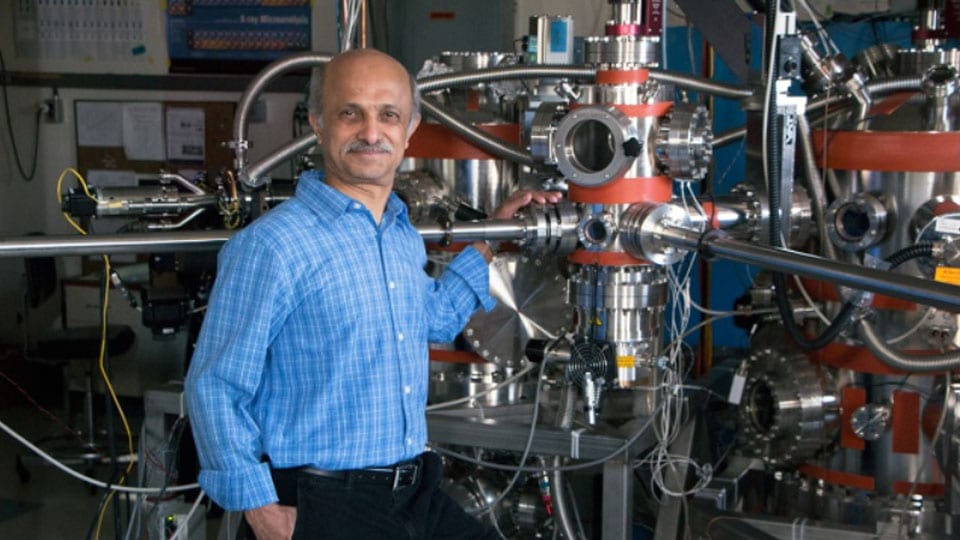
Now I was delighted to see that one of my classmates in MSc, Physics at Manasa Gangotri, Mysore (1973 batch) has achieved significant breakthrough in the research field of Quantum Physics working in the MIT, USA. I want to share his story to the audience here as a tribute to his achievements.

I am reproducing the article which had appeared in the “Star of Mysore” on May 4

He is the second of my old friends who appears to have achieved global recognition for contribution in his field. The other proud classmate from my High School days was Colonel Gopal Kaushik who had a key role in the Indian nuclear test at Pokhran in May 1998.

I am proud to have the association of these two gentlemen and salute them for their achievements.


New Discovery By Kodagu-Born Dr. Jagadeesh Moodera And Team At MIT

It boggles the mind when told that a subatomic particle exists simultaneously at two different spots.  One location could be on your table and the other on the surface of Jupiter!

English Physicist Paul Dirac theoretically proved way back in 1930s that fundamental particles known as fermions should have a counterpart somewhere in the universe with an opposite charge – known as anti-particle.

Complicated. Difficult to fathom. I fail to comprehend.  Based on this theory it is theoretically possible to have ‘teleportation’ that are portrayed in science fiction movies and books.

Coorg-born Physicist Dr. Jagadeesh S. Moodera has been a scientist at Massachusetts Institute of Technology (MIT) since 1981. He has several path-breaking research papers to his credit. My wife and I had the good fortune of a guided tour of his laboratory at MIT during our visit to Boston to attend the Kodava Convention-2019, in September last year.

Dr. Jagadeesh explained the intricacies of the experiments that he and his team were involved in.   It was fascinating to see a huge setup with myriad tubes, probes, cables and instruments in order to create a 100% vacuum in a space of about 2 cubic centimetres.

Part of the experiment was conducted in this small space which was absolutely contamination free.  There was another setup equally complicated where a space was created for the experiment which was free of any kind of vibration – not even that created by the traffic in the streets distance away, or footsteps of students in the nearby corridors.  In addition, this space is cooled to -273 degree centigrade (that’s as close as one could get to -273.15 degree centigrade which is absolute zero).   The experiments were conducted under these ideal conditions and usually between 10 pm and 6 am when chances of vibration were the least.

The experiment Dr. Jagadeesh and his colleagues have been working on since 2012 was to discover what Italian Theoretical Physicist Eltore Majorana, extending on Paul Dirac’s theory, had postulated in 1937 that there should be some subatomic particles that are indistinguishable from their anti-particle.

Scientists have been looking for these particles named Majorana fermions. Many theories have emerged over the years.  Theoretical Physicists at MIT and elsewhere predicted that Majorana fermions may exist on solids such as gold under certain conditions.   Dr. Jagadeesh and his team were on a mission to discover the existence of the elusive Majorana fermion.

The experiment, extremely complicated, needed many long hours in the laboratory.  Dr. Jagadeesh explained how the delicate research was carried out at nano-particle level and observed through Scanning Tunneling Microscope (STM).  STM is capable of ‘feeling’ the presence of atoms and molecules.  3mm x 3mm was the size of the surface on which the experiment was carried out, consisting of nano-wires of gold, grown on superconducting material: Vanadium.

MIT News dated 10th April 2020 has announced the successful sighting of the mysterious Majorana fermion by Dr. Jagadeesh Moodera and team. This is a major breakthrough.   In Dr. Jagadeesh’s words ‘We have shown they are there, and stable, and easily scalable.’  Please visit webpage: http://news.mit.edu/2020/first-majorana-fermion-metal-quantum-computing-0410

The finding that Majorana fermions are scalable and could be made into qubits (individual computational units) is spectacular.  These qubits could be used to build the most powerful and error free quantum computers. This will be a step closer to the phenomenon known as Singularity, which predicts that by the year 2042 AD there will be computers that will have computing power of all the human brains put together!

Once Singularity is achieved, humans need not invent anything further.  Solutions to the most complex problems will be arrived at within seconds.  If we had these computers today, a remedy for the current Covid-19 would have been found in a jiffy!

Dr. Jagadeesh’s wife Dr. Geetha Berera is a senior lecturer in MIT and we had an opportunity to visit her laboratory as well.  The couple are totally dedicated to academics and research. Every year they visit Coorg and conduct a Quiz programme for school students.  They are in the process of starting a school in Coorg under their organisation – CREATE Gurukula Trust – focusing on encouraging young minds in research activities.  Meritorious students at Coorg Institute of Technology (CIT) are recipients of annual scholarships and awards instituted by Dr. Jagadeesh and Dr. Geetha. Dr. Jagadeesh and Dr. Geetha are eminent role models for young Kodavas to emulate.

Posted in Cyber Law | 1 Comment

Spreading Awareness of PDPA-India

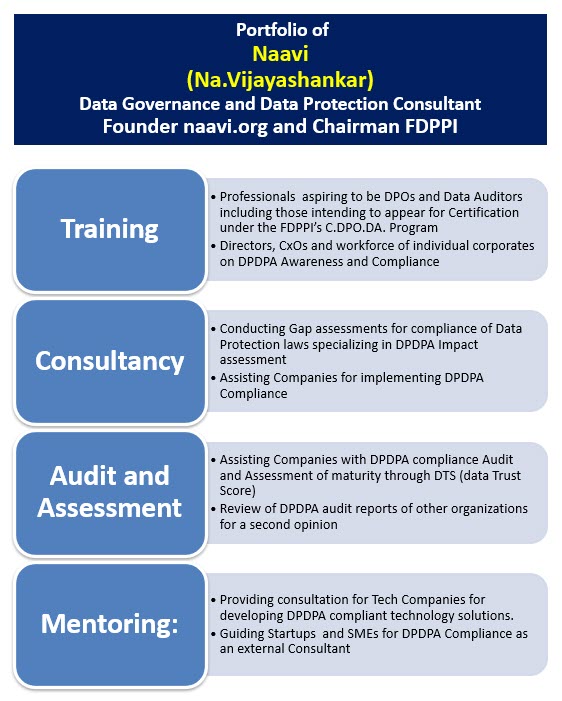
After FDPPI completed the two certification programs for Data Protection Professionals (CDPP-I),  with a program of 18 hours of online teaching, Cyber Law College of Naavi has completed one more crash course of 12 hours for about 45 participants mainly from the Elite CISO group of Delhi.

Presently another batch of around 40 persons from Elite CISO are undergoing another crash course program for 12 hours.

While Naavi is conducting these sessions and Cyber Law College is providing the participation certificates, these participants are also eligible to move further on to take up the Certification examination of FDPPI and get certified if they are interested in the certifications.

Naavi/Cyber Law College/FDPPI acknowledge the enthusiasm of the members of the Delhi chapter of Elite CISOS and more particularly Mr Vikas Arora in making this spread of knowledge possible.

Creating wide awareness of the Personal Data Protection legislation as it is emerging in India now is essential to ensure an early adoption of the act when it finally becomes a law.

Naavi

Posted in Cyber Law | Leave a comment

Is Arogya Setu a Privacy threat? or a Security shield?

Critics are endangering the silent majority

There are a class of critics in India who donot spare any opportunity in taking a dig at the Government for every decision and also take the issue to the Courts to challenge every day to day operations of the Government.  This has happened earlier in respect of the ITA notification on Section 69 and Section 79 when Government wanted to make some amendments to the notification and the critics cried foul and went to the Court to stall the Government move. This frequent invocation of Court intervention by publicity hungry PIL lawyers supported by a section of the media which always highlights such opposition has posed many avoidable challenges to the Governance.

However, as a part of the democratic tradition of our country, it is necessary for us to accept such challenges.

At the same time, it is necessary for that section of the population which is in agreement with the move of the Government and is opposed to the critics not to hesitate coming out with their own opinion countering the objections despite it looking like swimming against the tide. But it is always the silence of the majority that enables the minority to create disproportionate noise and if we need to prevent misconceptions spreading out in the community, it is necessary to be vocal to express what we believe as true and face the backlash if any.

Naavi.org has been following this tradition since the 1998 when it started out its activity first under naavi.com and naavi.org (before naavi.com it was squatted by somebody else and had to be dropped).

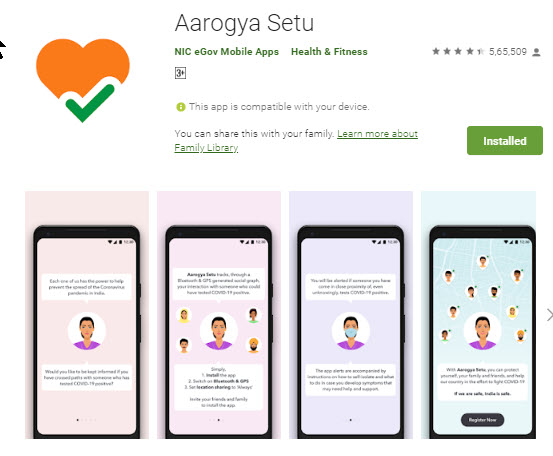
Currently we have an occasion to express our views on Aarogya Setu the App which the Government of India is promoting as a measure towards mitigation of the Covid19 spread risk.

After the COVID Lockdown, there have been discussions on the strategy for lifting the lockdown and allowing the movement of people, starting of business activities in a manner that would not ignore the possibility of a spurt in the infection cases. One of the arguments have been that economy cannot be for ever put under lock down and we need to restart immediately.

If however, there is an increased incidence of infections, while we keep the medical defense ready, we also need to improve our ability to track the movement of an infected person in the immediate previous 14-30 days to alert all those who came in contact with an infected person. Such persons can undertake a test and be assessed. If they are infected, they need to be treated. If not they could continue their activities with confidence.

In view of this requirement, worldover, Governments started introducing mobile based “Contact tracing apps”. These apps could use Bluetooth and GPS tracking of the mobile and based on other mobiles with similar apps could generate alerts when an infected person came near another non infected person. Such GPS based tracking has been regularly used by the advertising industry to provide information of services available around you (including Uber and Ola) and also for identifying your social media contacts if they are around.

The “Critics” who have so far been tolerant of the GPS based apps who bought the location information mostly from Google through their licensed mapping solution, have suddenly turned aggressive when the Indian Government wanted to introduce an App which could track the movement of the device holder in the immediate past. Along with this, the app provides some useful Covid information.

But the most important reason why this App is needed is to enable a healthy individual to avoid interaction with another person who may have either been positively diagnosed  for COVID or is suspected to be a carrier.

There have been two types of objections to this App. One is that it violates the privacy of an individual because it tracks his physical location. Second is that the information gathered may be misused for surveillance. One is a professional Privacy and Information Security argument and the other is purely political.

We shall restrict our discussion to the objections from the professionals and leave out the objections raised by Rahul Gandhi or Sashi Tharoor which are political comments. These politicians are known to pursue their agenda irrespective of the damage they may cause to the nation and it is their privilege  to do so. But many professionals are unable to keep their discussions free from political considerations and hence some of the criticisms from Privacy and Security professionals become coloured with prejudice and confuses an ordinary person.

The App which was launched on April 2, was first pushed by the PM on 14th April 2020 and  got critical attention when on April 29, the Government issued a circular that it is compulsory for all Government employees returning to work to download the app and keep it in operating conditions. This raised the bar since the Government was making it partly mandatory. In the private sector the employers were made responsible for similar compulsion if they wanted to re-open their business and allow the employees back to the offices.

The order of May 1st by the Government is said to have pointed out to Section 188 of IPC which suggests imprisonment upto 1 month for disobeying a lawful order of a Government servant.

The Privacy activists now have a serious objection for the mandatory nature of the need to download the app and to keep the Bluetooth and GPS tracking on at all the times because they consider it their right to privacy to hide their physical location at any point of time. Some Security specialists like the French citizen “Robert Baptiste” who uses the twitter handle “Edward Elliot” (Information from Wikipedia), also pointed out what they called as bugs in the app which could be considered as a security risk.

Many of these critics are advising public how to cheat the App and such advise can only be termed as lack of concern for national safety.

In Noida, a group of residents have started a legal battle against the local administration. They have now filed a police complaint and intend to take it up further with who else but the Supreme Court. In Kerala a Congress leader has already moved the High Court against the usage of the App and got notices issued to the Government.

While the Government fights the Covid19 at the medical level, it has been dragged into other side battles to divert its attention.  We need to wait and see whether the Courts would be able to see beyond technicalities and political prejudice and come up with decisions in the larger interest of the community since most of the persons who oppose the petitions may not be able to represent themselves in the Court while the supporters of the petition can engage the services of advocates who can argue that a Mango is an Orange if they are suitably paid and do it convincingly enough for the Judges to appreciate.

The Privacy Concerns

Some of the privacy concerns that have been expressed are that

  1. Aarogya Setu collects personal information of an individual without his or her consent
  2. The use of the app is made mandatory for all citizens
  3. App is tracking the location of the mobile continuously
  4. App collects personal information  such as name, phone number, age, sex, profession, countries visited in the last 30 days and whether a person is a smoker or a non smoker and his or her medical condition.
  5. Use of the App raises the risk of “institutionalization of mass surveillance”
  6. Use of the app urges people to Pre-emptively take tests and overwhelm the public heath systems prematurely
  7. Use of the app inadvertently discriminates against regions which have fewer concentrations of smartphones

The Internet Freedom Foundation (IFF) which is spearheading the legal action in Noida has raised its objections through a letter written to the parliament members  and will soon approach the Supreme Court for relief agains their concerns some of which are common with the case filed in Kerala High Court.

The main argument against the app is the “mandatory nature” of the order for employees. Otherwise, the consent is provided by the people who download and the privacy policy indicates the use of the information which may pass the test of reasonableness given the present public health emergency which we are in. The security objections raised by Edward Elliot have been found to be only peripheral issues not serious enough to be worried about. The objections of IFF on overwhelming of public health system etc are gap fillers in the petition and donot need attention.

The Government has also clarified that the data collected is stored in the user’s device and would be deleted in 30/45 days. Hence most of the Privacy concerns are being addressed.

No Need to Put the Source code in the open

There is one demand that the Aarogya Setu source code should be put in the open source. It is not recommended since hackers are waiting to subvert the system and whether they call themselves “Ethical” or not they cannot be trusted.

“Obfuscation” of the code is an information security strategy and the Government should secure its source code to prevent motivated attacks.

Circular should  be Re-worded

We need to therefore come back to the “Mandate” and the pointing out of Section 188 of IPC.

The Government as usual has not anticipated the possibility of the opposition mounting this attack through the legal challenges and perhaps thought that we are in the era of “Dharma Yuddha” where in times of crisis, certain norms of opposition would be followed. But for the Duryodhana clan, everything is fair in politics and pulling the rug under the Government even at the time of this crisis is only a fair game.

As a result of this, the Government failed to put its circular in the proper perspective and has given a handle to the opposition to beat itself. The only saving grace for the country is that we have a PM who is not allowing himself to be distracted from his goal and doing his best to take steps towards mitigation of the Covid19 risk in a manner he thinks is best. All the critics are not able to provide any alternatives but are only happy to criticize. They deserve to be ignored.

I however suggest that the Government should re-issue the circular of May 1 with a cover note where it should state as follows:

“Lockdown continues until further notice and no body should move out of their houses unless they have necessary pass issued by a Government authority.

However, exception would be granted to those individuals who voluntarily submit themselves to a discipline which includes social distancing, wearing of masks and keeping an active Aarogya Setu enabled smart phone.”

If people realize that it is in their own interest to know if the person next to him is not a person who has recently returned from a vulnerable foreign country or was a person who was assessed infected less than 45 days back, they would gladly agree to use the App.

The Organizations and the Government have every right to secure their working area by mandating that employees will continue to be on work from home location unless they start using the Aarogya Setu app in the interest of other employees with whom they may come into closer contact if they attend the office.

It is the right of other employees who have downloaded the App in their own health interest to insist that no dilution of this order should be permitted.

Courts whether it is the Supreme Court or the Kerala High Court should not take any decision without considering the rights of this silent majority of people who are concerned with their colleagues who may be carriers of the infection and may join employment by disabling the Aarogya Setu app or the Bluetooth/GPS  functionality because they have a false sense of them being Privacy warriors. If the Courts ignore the safety of this section of people who are 9.5 crores at present, it will only display a judicial impropriety that is avoidable.

Digital Rights Survive if we survive COVID-19

For activists,  I would request them to check their own suggestion on storing of the information in the device etc as provided in their website and accept the Government clarification in this regard. If they shed their anti-government attitude they will agree that this app has a purpose and we don’t gain anything by killing it.

Activists  should also spend their energy more fruitfully and look at the Net Neutrality concept being adversely affected by the Alphabet & Apple agreement on sharing of GPS data, the Bois Locker room issue, the INS attack on WhatsApp admins, Banning of Tiktok, Banning of Crypto Currencies etc., which are all representations of misuse of Internet Freedom,  rather than focusing only on anti Government issues.

Activists should realize that Digital Rights will survive only if we survive COVID-19. Let us fight COVID-19 first and then focus on digital rights.

Pass Personal Data Protection Bill 2019 immediately

The petitioners who have approached the Courts will be pointing out that the lack of a Privacy Protection Law is allowing the Government to indulge in this excess.

I wish that the Government takes the cue and based on whatever public comments already with it, go for immediately passing the Personal Data Protection Bill 2019 after conducting virtual meetings of the Parliamentary committee.

PDPA has the exceptions under which the Aarogya Setu could operate as a Sandboxed scheme.

Naavi

(Views expressed here and in other articles on this blog are entirely the personal views of Naavi)


Posted in Cyber Law | 1 Comment