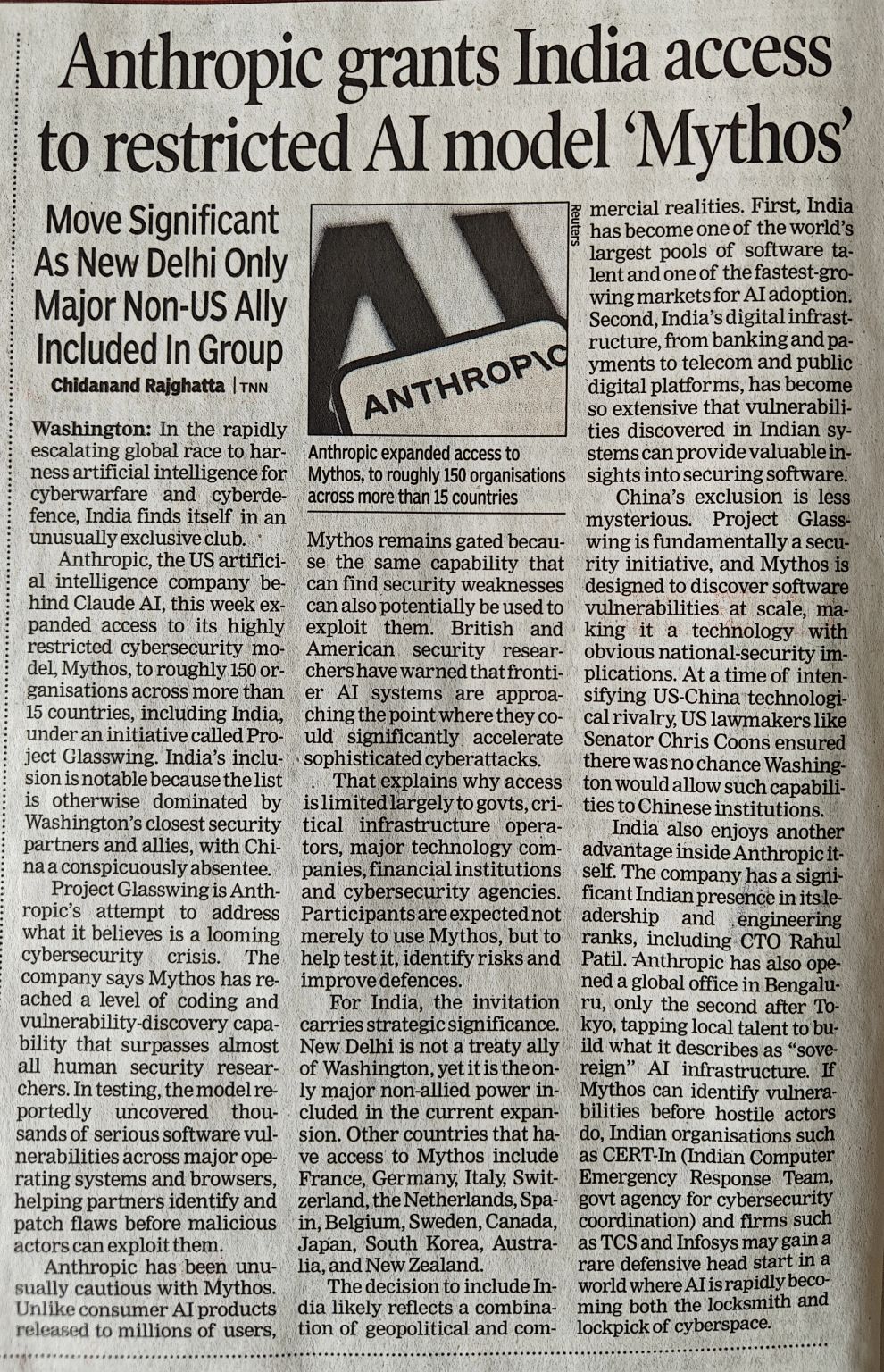
A recent news report indicates that Anthropic, the company behind Claude AI, has extended access to its highly restricted cybersecurity-focused AI model “Mythos” to a select group of organizations across several countries, including India.
What makes this development noteworthy is that India appears to be the only major non-US allied nation included in the current group, while China remains excluded. This signals a growing international recognition of India’s role in the global cybersecurity ecosystem.
Unlike conventional AI models designed for general-purpose applications, Mythos is reportedly capable of identifying software vulnerabilities at a scale that rivals or exceeds human security researchers. Such capabilities can help organizations discover weaknesses in operating systems, browsers, and enterprise software before malicious actors exploit them.
The significance of this development extends beyond technology.
First, it reflects confidence in India’s software talent pool, digital public infrastructure, and cybersecurity capabilities. India’s vast digital ecosystem—spanning banking, telecommunications, digital identity, payments, and public services—offers a unique environment for testing and improving cyber defence technologies.
Second, the move highlights the growing geopolitical importance of AI. Advanced cybersecurity AI tools are increasingly becoming strategic assets comparable to cryptographic technologies, advanced semiconductors, and other national-security capabilities. India’s inclusion in this restricted circle suggests that it is being viewed as a trusted participant in the emerging global AI-security architecture.
Third, the development should be of particular interest to Indian regulators, DPOs, cybersecurity professionals, and Independent Data Auditors. As AI systems begin to play a direct role in vulnerability discovery, risk assessment, and cyber defence, questions of accountability, transparency, governance, and compliance will become increasingly important.
For India, access to such technologies can provide a significant defensive advantage. At the same time, it underscores the need to develop indigenous capabilities so that cybersecurity resilience is built on sovereign foundations rather than dependence on foreign-controlled platforms.
Whether Mythos ultimately proves as transformative as its proponents claim remains to be seen. However, the message is clear: cybersecurity is rapidly becoming an AI-driven domain, and India has now been invited to participate in shaping that future.
The challenge before India is not merely to use such technologies, but to build the governance, audit, and assurance frameworks necessary to ensure that AI-driven cybersecurity remains accountable, trustworthy, and aligned with national interests.
Naavi