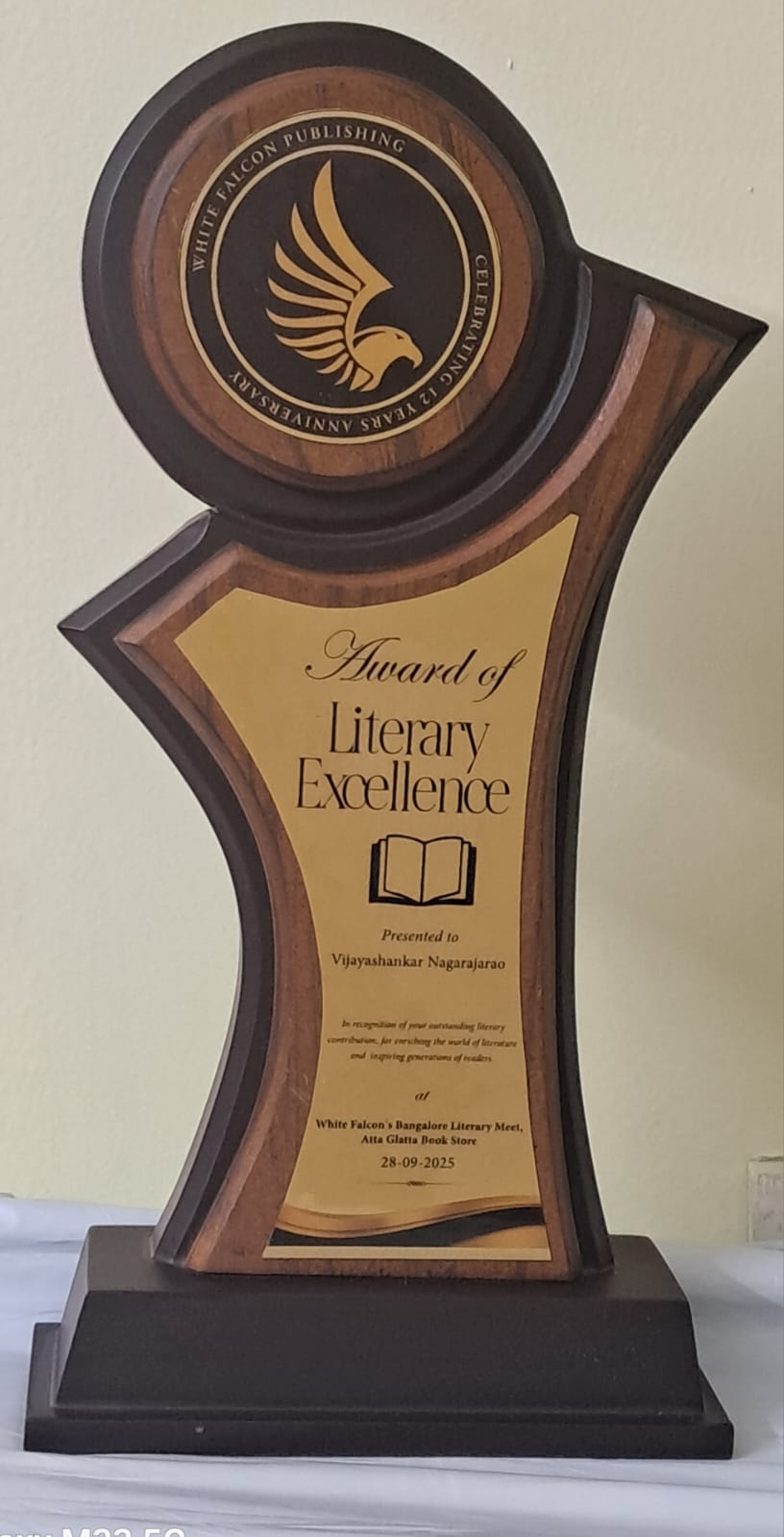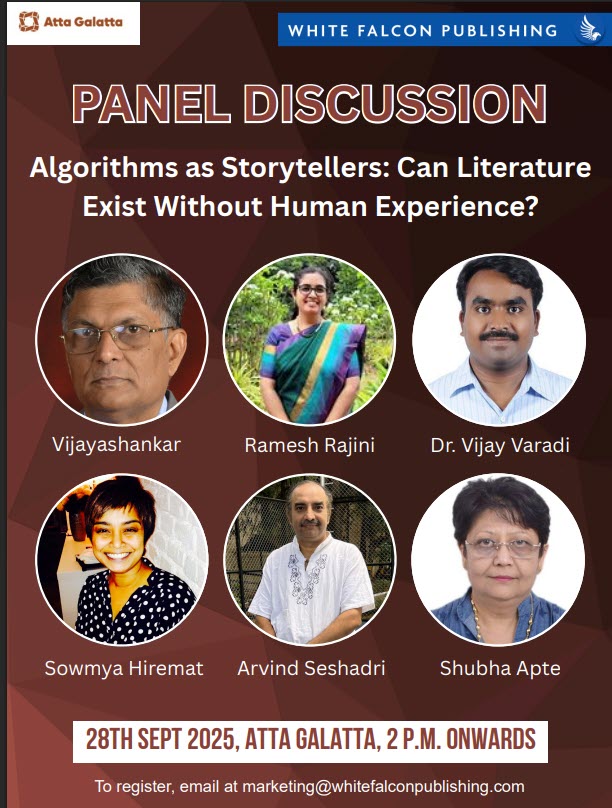

 After the intense discussions on AI in the context of DPDPA Compliance in our IDPS 2025, yesterday, I was in a literary meet organized by White Falcon Publishing which has published my book DGPSI-“The perfect prescription for DPDPA Compliance” and is in the process of publishing the next book “Taming the twin challenges of DPDPA and AI with DGPSI-AI”.
In the gathering there were professors who have written books on Agentic AI, Have taught AI as part of their corporate training responsibilities and also those who have worked with AI for a long time as part of their work responsibilities. It was a gathering which had more in depth AI specialists than what we can normally find in an IDPS seminar.
It was interesting to discuss in the context of writers the pros and cons of AI. While as Risk Management specialists we frown upon the AI for its hallucination vulnerability that renders it “Unpredictable”, the gathering of authors represented fiction writers who can make use of AI to create literary works. They obviously benefit from the “Creative abilities” of an AI algorithm.
There is no doubt that there are many in the industry who use AI under their tight leash of human oversight who also consider AI as a friendly tool.
Hence it is clear that AI has two faces namely the “Risky face” as well as the “Friendly Face”. This reminds me of the famous story of “Dr Jekyl and Mr Hyde” about the “Split personality” of an individual. AI also exhibits this split personality of being the friend in one context and a dangerous assistant on another context who can push us into a catastrophic situation.
This is more evident in the Generative AI scenario. However since other forms of AI including the Agentic AI and the Analytical AI use Generative AI in some aspect, most of the AI models are a combination of all these three capabilities. We may therefore consider AI models to be a three way personality which involves cold calculations, generative forecasts and execution of decisions.
Just as today the world of data representation is moving from Binary representation to trinary (or ternary) representation (where each bit represents three value states, -1,0 and+1) , the AI models have to be looked at as a combination of the traditional analytical tool with the Generative capabilities built out of training from large data, with execution responsibilities of an Agentic AI that interacts with the external world.
Some AI specialists say that “It is all in the Prompting”. If your prompt is constructed well, you may get the positive qualities of an AI and if your prompting is bad you may get bad and some time rogue responses.
Yes this could be a good excuse to say that AI is Afterall a technical tool and its utility depends on how we use it. But for a Risk manager, whatever may be the risk and whether it is of technical origin or human origin, Risk is a Risk that needs to be mitigated. Hence understanding the three way split personality of an AI is essential.
I have earlier alluded to the “I am OK-You are OK” principle in the context of Machine Learning phase of the AI development where the personality of the end AI model may depend on the training methodologies used.
Today we can also take the Eric Berne’s PAC model of Transactional Analysis to explain the three way split personality of the AI.
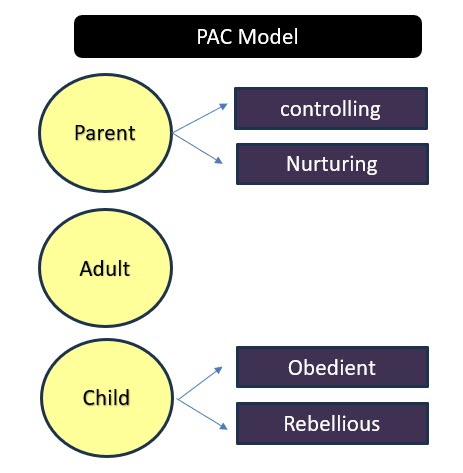
The behaviour of a Child as either an obedient/adapted child or a rebellious It looks similar to the “Behavioural” responses of our children when some times they transact child depends on the parental training which may emanate from either the controlling parent or nurturing parent. Saying that the behavioural issues of an AI model is only in the in the “prompting” is to assume that AI always behaves in an Adult-Adult transactional mode.
But the truth is that AI model may also have its own Child behavioural characteristics which could be considered as a creation of its “Parenting”.(Machine Learning with Training Data inputs”).
The adaptive behaviour of an AI is the expected behaviour of a deterministic decision making like any other software. The rebellious nature is the “Natural Child Behaviour” where the AI may exhibit the “Creative tendencies”. The guard rails we create during parenting of an AI are the controls which try to make AI behave appropriately.
In this perspective, I present a behavioural model for studying and explaining the behaviour of AI either as a conformist and Obedient assistant or as a creative supporting assistant or an unfriendly rogue assistant.
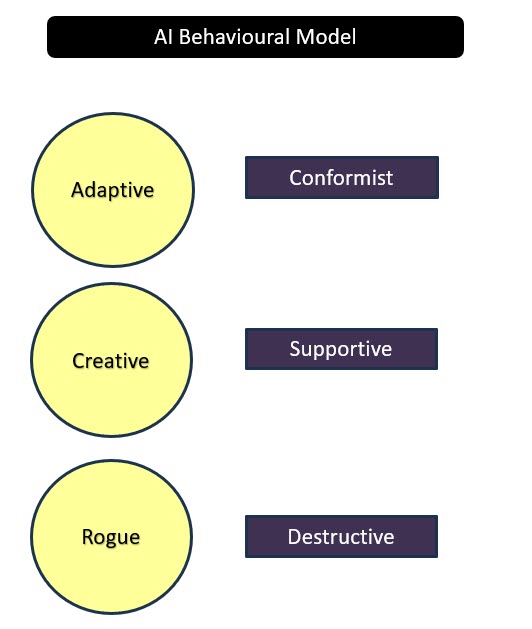
These are early days of development of this “Naavi’s theory of AI behaviour modelling” and let us start developing the thought process of what kind of an AI model a deployer wants and whether the developer can provide such variants through customization of temperature setting alone or by providing a set of guard rails to be configured by the deployer so that “Prompting” does not entirely determine the hallucination or rogue behaviour of an AI model if the deployer does not want it to be so.
I invite comments for further developing this thought.
 (P.S: AI Generated synthetic content)
Naavi