
Following the comparison of AI definition in the Supreme Court AI framework and the DGPSI definition a need for refinement of the AI definition for DGPSI auditors has arisen.
At present, the DGPSI definition of AI followed the description provided under this article” Defining of AI: DGPSI approach” . Now the revised thought is as follows.
The objective of the revised DGPSI definition presented here is designed to keep the framework’s distinctive strength , that it triggers on the loss of human control rather than on a list of technical features , while curing the four ambiguities the earlier analysis identified: the undefined “acceptable threshold,” the mismatch between the control-based headline and the capability-based classes, the unstated relationship between the classes, and the “code-correcting” literalism.
Proposed definition
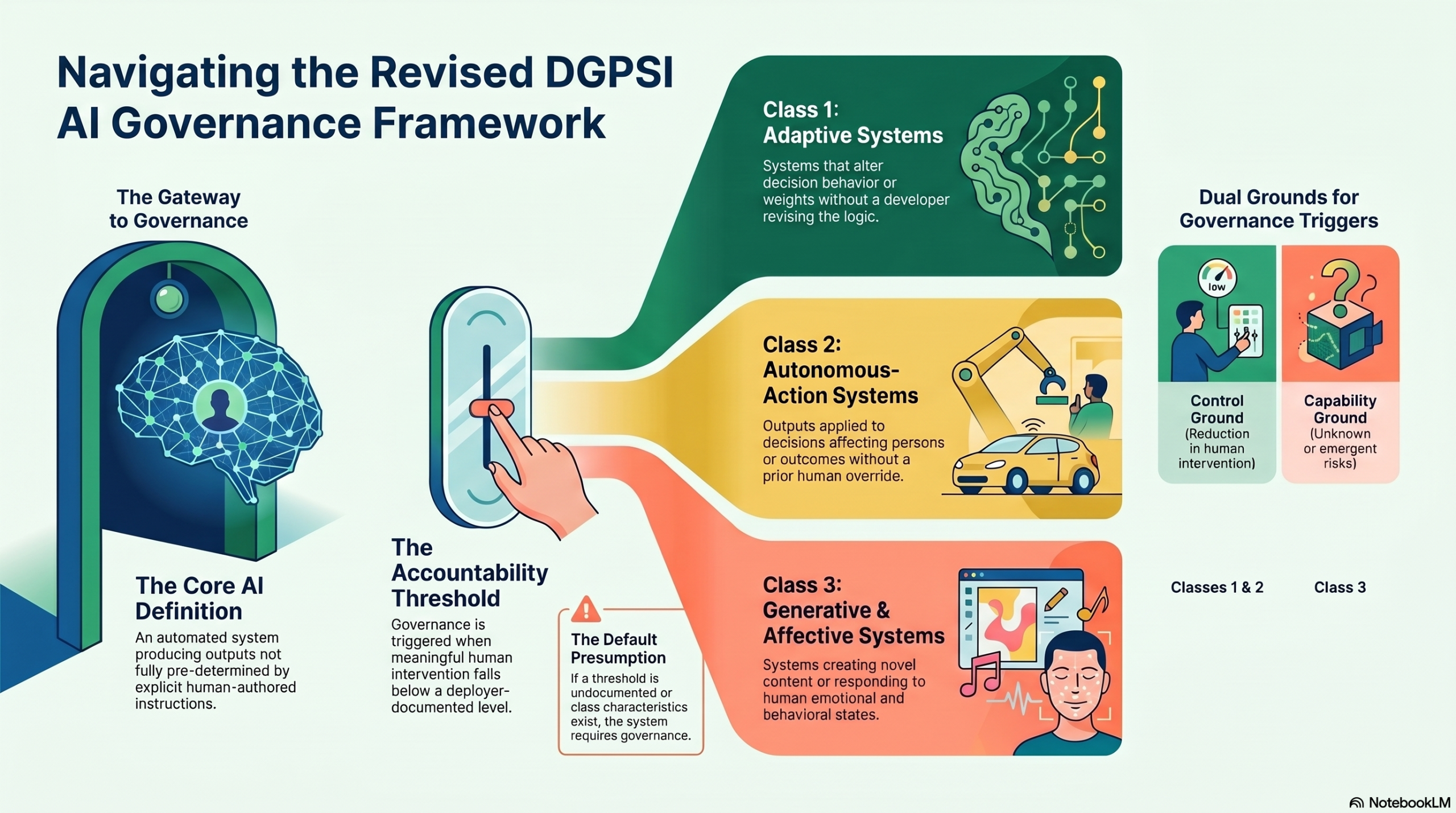
Core definition (the gate). An AI System is an automated data-processing system that, for a given input, produces decisions, predictions, recommendations or content which are not fully pre-determined by explicit human-authored instructions, because the system derives or adapts its own processing logic from data, models or probabilistic methods.
Accountability threshold (when the Standard applies). A system within the core definition is governed by this Standard where the degree of meaningful human intervention in either (a) the formation of its output, or (b) the application of that output to a decision affecting a person or a business or legal outcome, falls below the accountability threshold.
The deployer shall define and record the accountability threshold for each system in its risk documentation. In the absence of such a record, or where the system exhibits any characteristic in Classes 1 to 3 below, the threshold is presumed to be crossed and the system is treated as an AI System requiring governance.
Classes. The three classes are independent risk vectors, not an ascending scale, and are not mutually exclusive; a system may fall within more than one, in which case the obligations attaching to each apply cumulatively. Governance intensity (Low / Medium / High / Critical) is fixed by the risk tier, not by the class number.
- Class 1 — Adaptive (self-learning) systems: a system that alters its own decision behaviour — by adjusting parameters, weights, rules, embeddings or operative prompts — without a human developer revising the underlying logic for each such change.
- Class 2 — Autonomous-action (automated-decision) systems: a system whose output is implemented, or applied to a decision affecting a person or a business or legal outcome, without a human being able to review and override that specific output before it takes effect.
- Class 3 — Generative and affective systems: a system that generates novel content (including text, images, audio, video or code), or that infers, simulates or responds to human emotional or behavioural states.
Interpretation. A system falls within this Standard on either of two independent grounds: because human control has dropped below the threshold (the control ground — Classes 1 and 2), or because the system possesses capabilities that generate unknown or emergent risk irrespective of human control (the capability ground — Class 3).
Either ground is sufficient on its own.
How this corrects each ambiguity
- Undefined “acceptable threshold.” The threshold is no longer left floating. It is made procedurally determinate — the deployer must define and document it per system — and is backed by a default presumption: if it is undocumented, or any class characteristic is present, the threshold is deemed crossed. This also dovetails with DGPSI’s existing Deviation Justification Document discipline.
- Headline-versus-classes mismatch. The definition now openly rests on two grounds rather than pretending everything reduces to “human intervention below a threshold.” Classes 1 and 2 carry the control axis; Class 3 is expressly placed on a separate capability axis, with the note that its inclusion “does not depend on any reduction in human intervention.” The earlier slippage is resolved by acknowledging it rather than papering over it.
- Relationship between classes. It is now stated that the classes are independent, overlapping and cumulative, and that the number denotes risk type, not severity — so an agentic generative tool that is Class 1 + 2 + 3 attracts the combined obligations, and severity is read off the separate risk tier.
- “Code-correcting” literalism. Class 1 now refers to a system altering its “decision behaviour — by adjusting parameters, weights, rules, embeddings or operative prompts,” expressly not limited to rewriting source code. Conventional machine learning, which changes weights rather than code, is now plainly captured.
Short-form version (for the body of the Standard)
An AI System is an automated data-processing system whose decisions, predictions, recommendations or content are not fully pre-determined by explicit human-authored instructions. It is governed by this Standard where meaningful human intervention in the formation or application of its output falls below a deployer-documented accountability threshold — which is presumed crossed where the system
(1) adapts its own decision behaviour without per-change human revision,
(2) applies a decision affecting a person without a human able to override the specific output, or
(3) generates novel content or infers or responds to human emotional or behavioural states.
A useful by-product: the core definition sentence now mirrors the OECD / EU AI Act / draft Supreme Court descriptive boundary, so the revised DGPSI definition is interoperable with the Court’s definition.
Comments welcome.
(P.S: This revised definition of AI does not affect the DGPSI-AI framework implementations. Kindly note that SCAIF defines the Algorithmic Software a term used in DGPSI rules and hence there is a need for integration of the two definitions.)
Naavi







Pingback: Why the Supreme Court’s AI Draft Needs to Rethink “Court Data” and “Sensitive Judicial Data | Naavi.org