The earlier post on AIDAI as a milestone for FDPPI as well as for the Data Protection Eco system has elicited this comment.
“The article provides a thoughtful and timely perspective on the evolving data protection landscape in India and rightly characterizes the current phase as a structural milestone rather than a mere legislative event.
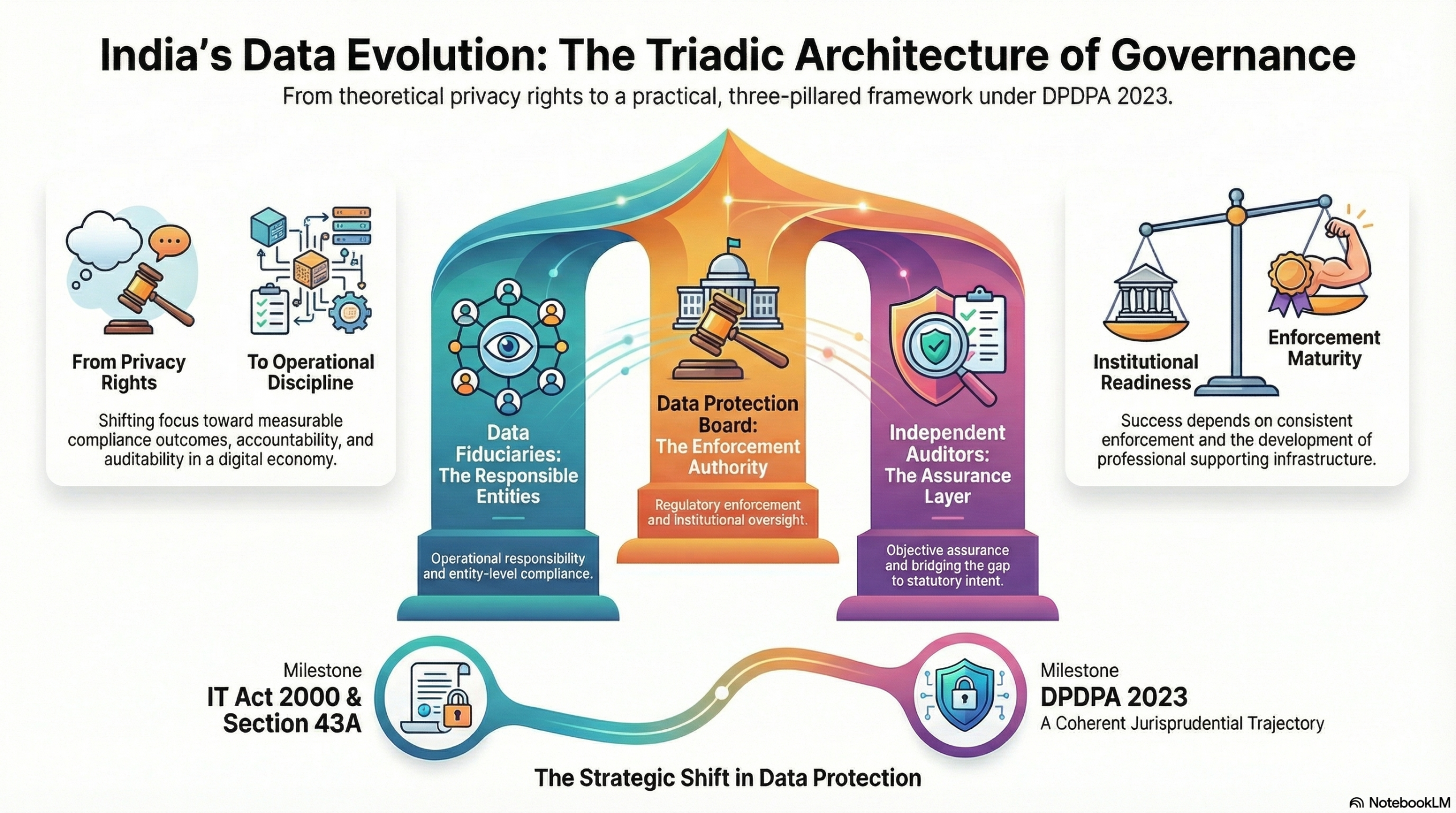
One of the key strengths of the article is its implicit shift in framing—from privacy as a conceptual right to data governance as an operational discipline. This is a necessary transition, especially in a rapidly digitizing economy where accountability, auditability, and measurable compliance outcomes are becoming central to regulatory expectations.
At the same time, I believe the discussion could be further strengthened by explicitly distinguishing between institutional readiness and enforcement maturity. While the notification of rules and the operationalization of the Data Protection Board of India represent significant progress, the effectiveness of the framework will ultimately depend on consistent enforcement, regulatory clarity, and the development of supporting professional infrastructure.
In this context, the article presents an opportunity to more explicitly recognize the role of independent assurance mechanisms. As envisaged under Section 10 of the DPDPA, the emergence of Independent Data Auditors will be critical in bridging the gap between statutory intent and operational compliance. Their role, analogous in some respects to financial auditors in corporate governance, can provide credibility, objectivity, and trust to the ecosystem.
Further, the article may benefit from articulating the evolving accountability architecture more explicitly—namely:
-
- Data Fiduciaries as responsible entities,
- The Data Protection Board as the enforcement authority, and
- Independent auditors as the assurance layer.
This triadic structure, if developed effectively, can form the backbone of a robust data governance regime in India.
Finally, a forward-looking closing that calls for capacity building, professional standardization, and institutional collaboration would strengthen the article’s impact and align it with the emerging needs of the ecosystem.
Overall, this is a well-argued and important contribution that moves the conversation beyond compliance into the domain of governance and accountability. With a slightly stronger emphasis on enforcement realities and the role of professional assurance, it can serve as a foundational reference for the next phase of India’s data protection journey.”