In February 2025, Naavi.org first discussed the concept of a “Super Data Fiduciary” in the context of the hospitality industry such as property sharing. In February 2026, we also discussed the concept in the context of Education Industry”. In this article we have taken the example of the Hospital industry and discussed how this concept is relevant.
One of the notable strengths of the Digital Personal Data Protection Act, 2023 (DPDPA) is its principle-based drafting. Instead of prescribing rigid organizational structures, the Act defines broad responsibilities and leaves organizations the flexibility to implement governance mechanisms appropriate to their business models.
This flexibility is particularly valuable because the architecture of modern enterprises has evolved far beyond the traditional “one company–one business–one customer relationship” model.
Today, organizations increasingly operate as enterprise ecosystems. A single trusted brand may represent dozens—or even hundreds—of legally independent entities connected through ownership, management agreements, franchise arrangements, joint ventures, shared digital platforms, centralized AI systems, and common governance structures.
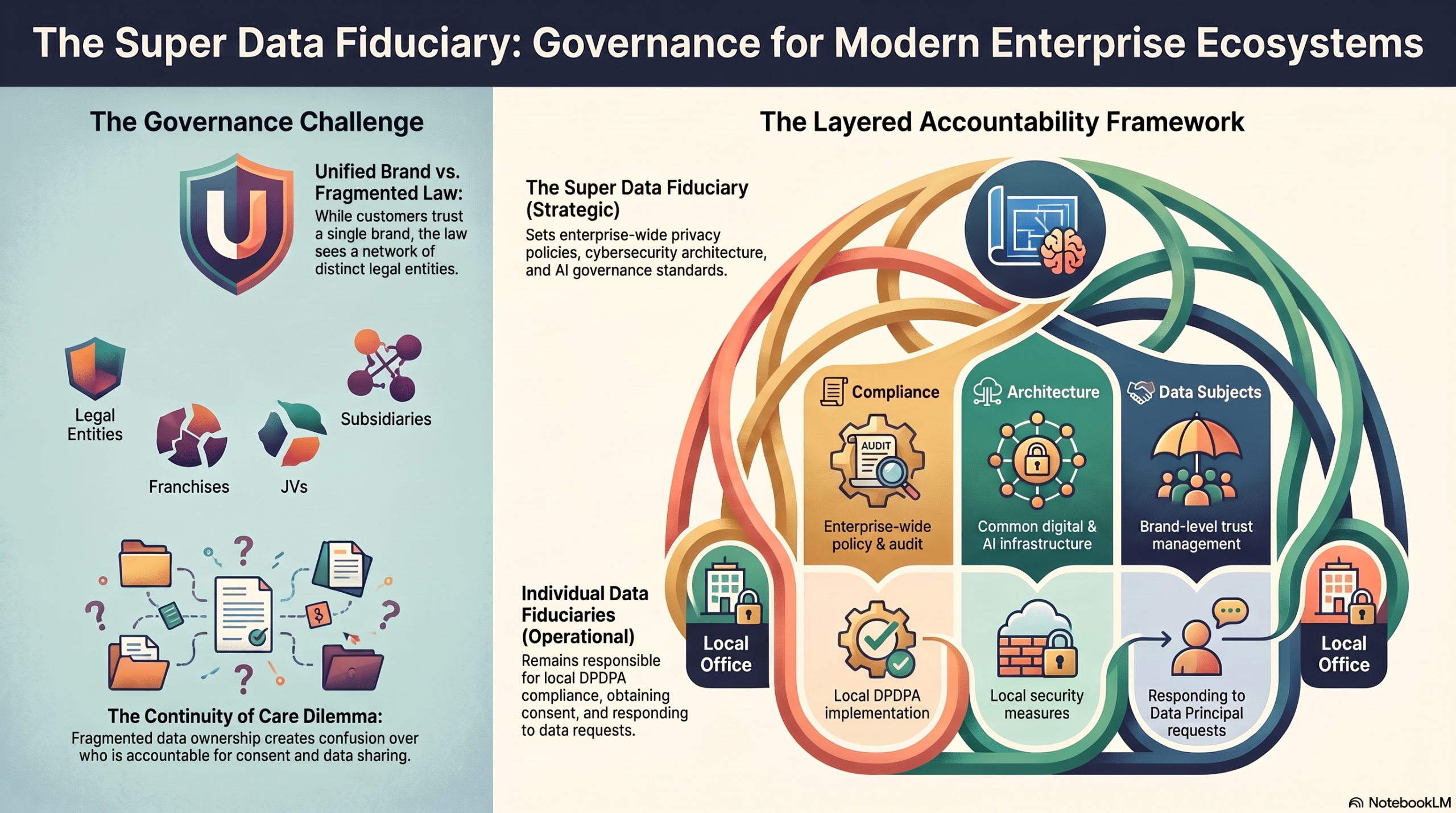
To the customer, the enterprise appears to be one organization. To the Companies Act, it is many. This divergence creates one of the most significant governance challenges in implementing DPDPA.
The Data Governance and Protection Standard of India (DGPSI) addresses this challenge by introducing a governance concept known as the Super Data Fiduciary.
It is important to clarify at the outset that the Super Data Fiduciary is not a new statutory category created by DPDPA. Nor should it be confused with the Significant Data Fiduciary (SDF) notified by the Central Government under Section 10 of the Act.
Rather, it is a governance designation created within the DGPSI family of sector-specific compliance frameworks to establish enterprise-level accountability wherever multiple autonomous Data Fiduciaries operate under a common identity.
The Classical DPDPA Model
DPDPA recognizes two principal operational actors:
-
- Data Fiduciary
- Data Processor
A Data Fiduciary determines the purpose and means of processing personal data.
This model functions effectively where a single legal entity independently manages its processing activities. However, contemporary business organizations rarely fit this model. The digital economy increasingly consists of networks of legally distinct entities that collectively deliver a seamless customer experience.
The legal model remains fragmented. The customer experience is unified.
Trust is Reposed in the Brand, Not the Corporate Structure
Consider a nationally recognized healthcare brand such as Apollo Hospitals.
Apollo serves as an excellent illustration—not because it is unique, but because it reflects a governance model that is becoming common across industries.
Today, the Apollo ecosystem includes entities operating under a variety of legal arrangements:
-
- wholly owned hospitals,
- managed hospitals,
- joint venture hospitals,
- franchise hospitals,
- diagnostic centres,
- pharmacies,
- home healthcare services,
- telemedicine platforms,
- centralized appointment systems,
- digital health applications.
Many of these may be separate legal entities.
Yet no patient walks into a hospital asking,
“Which incorporated company owns this facility?”
The patient simply says,
“I am going to Apollo.”
The trust relationship exists with the brand. The privacy expectation also exists with the brand. The Data Principal neither knows nor reasonably expects to know the legal complexity behind the enterprise.
The Governance Challenge
Consider a common situation.
A patient undergoes treatment at one Apollo hospital. Several months later, the patient visits another Apollo hospital in a different city. The doctor accesses earlier medical records.
From the patient’s perspective, this continuity of care is expected. However, several governance questions immediately arise.
-
- Which hospital is the Data Fiduciary?
- Which entity obtained the original consent?
- Which entity authorized inter-hospital data sharing?
- Who must respond to a request for correction?
- Who determines retention periods?
- Who becomes accountable if data is disclosed improperly?
The answers are no longer confined to one organization.
Distributed Processing Means Distributed Responsibility
Modern healthcare is supported by interconnected digital infrastructure.
# Appointments may be booked centrally. Electronic Medical Records may be maintained on enterprise cloud platforms.
# Diagnostic laboratories may be located elsewhere.
# AI systems may analyse radiology images.
# Telemedicine consultations may be delivered from another city.
# Billing may be centralized.
# Patient relationship management may be managed by another company.
# Each participating entity processes personal data.
# Some determine purposes. Some determine means. Some merely process on behalf of others. Others establish governance policies affecting every participant.
The traditional distinction between Data Fiduciary and Data Processor is therefore insufficient to explain enterprise accountability.
The Missing Layer
Large enterprise ecosystems almost always contain an organization that performs functions extending beyond any individual operating company.
This organization may:
-
- own or license the brand,
- prescribe enterprise privacy policies,
- establish cybersecurity architecture,
- operate centralized digital platforms,
- define AI governance,
- standardize consent mechanisms,
- govern cross-entity data sharing,
- prescribe compliance standards,
- conduct enterprise audits,
- manage reputation risk.
Although it may not directly provide healthcare, retail services, education, hospitality, or banking, it exercises substantial influence over how personal data is governed throughout the ecosystem.
DGPSI identifies this governance layer as the Super Data Fiduciary.
What is a Super Data Fiduciary?
Within DGPSI, a Super Data Fiduciary is an enterprise-level governance entity that exercises strategic oversight, standardization, and accountability across multiple autonomous Data Fiduciaries operating under a common brand, platform, or governance structure.
The Super Data Fiduciary does not replace individual Data Fiduciaries.
Nor does it dilute their statutory responsibilities.
Instead, it provides enterprise governance wherever multiple organizations collectively create a unified customer experience.
The model introduces layered accountability rather than centralized liability.
A Layered Accountability Framework
Under the DGPSI model, accountability exists at two distinct levels.
Individual Data Fiduciaries
Each hospital, college, retail outlet, hotel, or financial institution remains responsible for:
-
-
- complying with DPDPA,
- obtaining consent where necessary,
- protecting personal data,
- responding to Data Principal requests,
- implementing local security measures,
- reporting personal data breaches,
- maintaining statutory records.
-
Super Data Fiduciary
The enterprise governance layer becomes responsible for:
-
-
- enterprise privacy governance,
- common data governance architecture,
- AI governance,
- cybersecurity standards,
- centralized digital infrastructure,
- inter-entity data sharing protocols,
- common consent architecture,
- enterprise audit,
- policy standardization,
- governance assurance,
- brand-level trust management.
-
The two responsibilities complement each other. One is operational. The other is strategic.
DGPSI-Hospital: Bridging the Governance Gap
One of the principal objectives of DGPSI-Hospital is to translate the broad principles of DPDPA into governance practices appropriate for healthcare institutions.
Healthcare differs fundamentally from many other sectors because data is inseparable from patient safety. Clinical information supports diagnosis, treatment, emergency intervention, medication management, continuity of care, and increasingly, AI-assisted healthcare delivery.
In healthcare, therefore, Data is Life.
DGPSI-Hospital recognizes that while individual hospitals remain statutory Data Fiduciaries, enterprise-wide governance frequently resides with the organization controlling the healthcare ecosystem.
Accordingly, DGPSI-Hospital designates that enterprise governance entity as the Super Data Fiduciary.
The Super Data Fiduciary establishes:
-
- enterprise privacy policies,
- EMR governance,
- interoperability standards,
- AI governance frameworks,
- cybersecurity architecture,
- centralized appointment systems,
- patient portals,
- telemedicine governance,
- enterprise incident response,
- consent management standards,
- audit programmes,
- vendor governance,
- enterprise risk management.
Every participating hospital continues to remain independently responsible for complying with DPDPA. The Super Data Fiduciary simply provides coordinated governance across the enterprise.
This approach does not require any amendment to DPDPA. It merely implements good governance within the flexibility already available under the Act.
Beyond Healthcare
Although healthcare provides perhaps the clearest illustration, the governance challenge exists across numerous sectors.
Hospitality
International hotel brands frequently combine owned hotels, managed properties, franchise hotels, centralized reservation platforms, loyalty programmes, and common customer databases.
Retail
Large retail chains operate through company-owned stores, franchise outlets, warehouses, logistics companies, e-commerce platforms, and centralized CRM systems.
Education
University systems often include autonomous colleges, online learning platforms, research centres, examination authorities, alumni organizations, and international campuses functioning under one institutional identity.
Financial Services
Banking groups commonly consist of banks, NBFCs, insurance companies, payment service providers, mutual funds, wealth management entities, and technology subsidiaries sharing customer onboarding, KYC infrastructure, fraud monitoring, and analytics.
Aviation
Airline groups operate code-share arrangements, loyalty programmes, reservation systems, airport services, cargo operations, and alliance partnerships while presenting a unified customer experience.
E-commerce
Marketplace ecosystems integrate merchants, logistics providers, payment gateways, customer service centres, advertising platforms, and recommendation engines.
Technology Platforms
Digital platform companies increasingly operate cloud services, messaging platforms, identity systems, AI assistants, payment services, and advertising ecosystems through multiple corporate entities under one trusted brand.
In every one of these sectors, the customer trusts the brand rather than the underlying legal entities.
Sectoral DGPSI Frameworks as Laboratories of Governance
Law evolves more slowly than technology. Waiting for legislative amendments whenever new organizational models emerge would impede innovation and delay effective compliance. Sector-specific compliance frameworks therefore perform an important jurisprudential function.
The DGPSI family—including DGPSI-Hospital, DGPSI-Bank/BFSI, DGPSI-Education, DGPSI-Retail, DGPSI-Hospitality, and future sectoral variants—provides governance mechanisms that address operational realities while remaining faithful to the existing provisions of DPDPA.
The concept of the Super Data Fiduciary is one such governance innovation.
It enables organizations to demonstrate enterprise-wide accountability without altering the statutory responsibilities of individual Data Fiduciaries.
Rather than waiting for Parliament to recognize every emerging organizational model, governance frameworks can evolve first. Over time, judicial interpretation, regulatory guidance, industry practice, and legislative refinement may adopt these concepts where they prove effective.
This is how jurisprudence develops.
Looking Ahead
The future of data governance will not be defined solely by individual organizations.
It will increasingly be shaped by enterprise ecosystems—networks of legally independent entities operating under common brands, shared technologies, integrated AI platforms, and unified governance structures.
DPDPA provides the legal foundation for protecting personal data. Frameworks such as DGPSI build upon that foundation by translating statutory principles into governance models suited to specific sectors and operational realities.
The Super Data Fiduciary is one such model.
It preserves the statutory autonomy and accountability of every Data Fiduciary while recognizing that enterprise-wide governance often resides at a higher organizational level. By introducing layered accountability, DGPSI aligns legal compliance with the expectations of Data Principals, who place their trust not in corporate charts but in the integrity of the enterprise they choose to engage with.
As India’s data protection jurisprudence matures, governance innovations of this nature will play an important role in ensuring that the law remains effective in an increasingly interconnected and AI-driven economy. The Super Data Fiduciary is not a departure from DPDPA; it is an evolution in its practical application—demonstrating how sound governance can anticipate tomorrow’s challenges while remaining firmly rooted in today’s law.
(..Comments are welcome)
Naavi