Attention is drawn to the notice issued by MeitY on 21st April 2026 related to the draft amendments to Information Technology (Intermediary Guidelines and Digital Media Ethics Code) Rules, 2021 in relation to strengthening intermediary compliance with clarifications, advisories and directions issued by the Ministry. (Refer here)
The last date for public comments was 7th May 2026 which is well behind us.
So far no confirmation of the final rules has come from MeitY.
The copy of the proposed draft rules are here. This should be read with the earlier consolidated rules published on 10th April 2026
An article which appeared in Indian Express today flagging some of the key issues of the rules is available here
While we await the release of the final rules, a brief review of the article of Indian express flag the following observations.
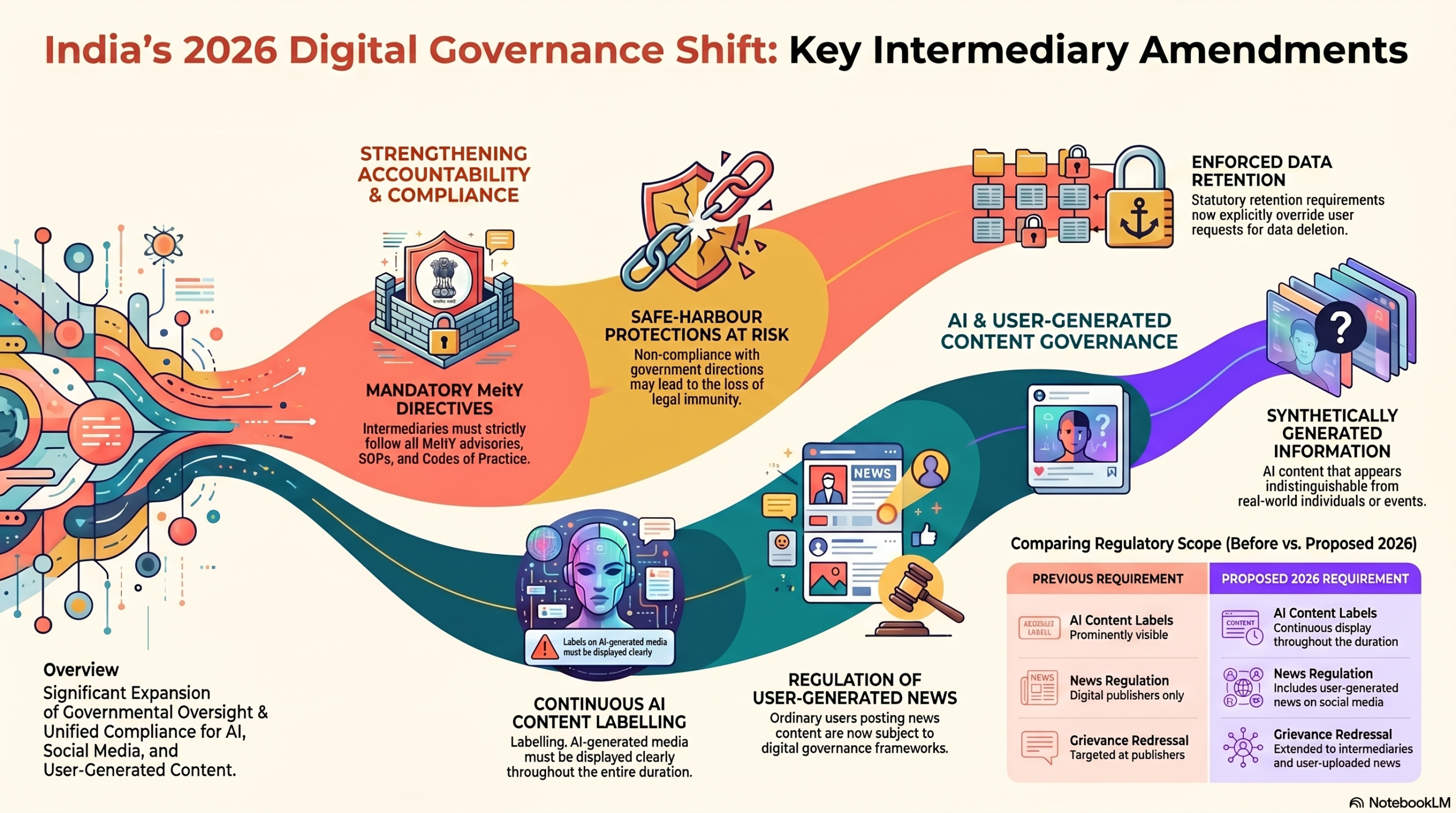
The proposed amendments represent a substantial expansion of governmental oversight over digital intermediaries. They move beyond traditional publisher regulation and seek to create a unified compliance framework covering:
- Social media intermediaries,
- AI-generated content,
- User-generated news and current affairs content, and
- Digital grievance redressal processes.
Although these amendments are not directly issued under the Digital Personal Data Protection Act, 2023 (DPDPA), they have important intersections with data governance:
- Data retention obligations may interact with DPDPA provisions relating to storage limitation and legal exemptions.
- AI-content labeling complements transparency principles relevant to responsible AI governance.
- Expanded intermediary obligations strengthen accountability mechanisms within India’s broader digital governance framework.
Key Proposed Amendments
1. Mandatory Compliance with MeitY Directives
Social media intermediaries, including platforms such as X and Meta-operated services, will be required to comply with:
-
- Clarifications
- Advisories
- Orders
- Directions
- Standard Operating Procedures (SOPs)
- Codes of Practice
- Guidelines
issued by MeitY.
Compliance with such directions will form part of the statutory “due diligence” obligations of intermediaries. Failure to comply could potentially affect the safe-harbour protections available under the Information Technology Act, 2000.
2. Enhanced AI-Generated Content Labeling Requirements
The amendment to Rule 3(3)(a)(ii) strengthens obligations relating to synthetic or AI-generated content.
Previous Requirement:
- AI-generated content labels needed to be “prominently visible.”
Proposed Requirement:
- Labels must be displayed continuously and clearly throughout the entire duration of the visual content.
Implication:
- Platforms will need robust technical mechanisms to ensure persistent disclosure of AI-generated videos, images, and similar synthetic media.
- The amendment reflects growing concerns regarding misinformation, deepfakes, and manipulated media.
3. Reinforcement of Data Retention Obligations
The amendments clarify that intermediaries must continue to comply with all legal requirements concerning:
-
- Preservation of information
- Retention of records
- Maintenance of evidence
even when responding to user requests or regulatory actions.
Implication:
- Data deletion requests cannot be used as a basis to circumvent statutory retention requirements.
- This provision aligns with law-enforcement, regulatory, and evidentiary needs.
4. Expansion to User-Generated News and Current Affairs Content
A major policy shift is the inclusion of news and current affairs content uploaded by ordinary users.
Previously, regulatory obligations primarily targeted recognized digital publishers.
Under the proposed amendments:
- User-generated news content may also fall within the regulatory framework.
- Social media platforms hosting such content become subject to additional compliance responsibilities.
5. Strengthening of Grievance Redressal Mechanism
Rule 14 has been revised to strengthen the role of the Inter-Departmental Committee (IDC).
The IDC may:
- Periodically hear complaints concerning violations of the Code of Ethics.
- Consider cases where prescribed timelines have not been met.
- Examine matters directly referred by MeitY.
6. Broader Applicability of Rules 14, 15 and 16
The amendment to Rule 8 extends the applicability of Rules 14, 15, and 16 beyond publishers.
These provisions will now apply to:
- Publishers
- Intermediaries
- User-generated news and current affairs content hosted on intermediary platforms
Implication:
- Regulatory accountability extends deeper into the social media ecosystem.
- Platforms may bear greater responsibility for content generated by users.
The entire impact of the modified rule hinges on the definition of the “Synthetically generated information” which is defined as follows.
Rule 2 (wa) ‘synthetically generated information’ means audio, visual or audio-visual information which is artificially or algorithmically created, generated, modified or altered using a computer resource, in a manner that such information appears to be real, authentic or true and depicts or portrays any individual or event in a manner that is, or is likely to be perceived as indistinguishable from a natural person or real-world event;
Provided that the purposes of this clause, an audio, visual or audio-visual information shall not be deemed to be ‘synthetically generated information’, where such audio, visual or audio-visual information arises from—
(a) routine or good-faith editing, formatting, enhancement, technical correction, colour adjustment, noise reduction, transcription, or compression that does not materially alter, distort, or misrepresent the substance, context, or meaning of the underlying audio, visual or audio-visual information; or
(b) the routine or good-faith creation, preparation, formatting, presentation or design of documents, presentations, portable document format (PDF) files, educational or training materials, research outputs, including the use of illustrative, hypothetical, draft, template-based or conceptual content, where such creation or presentation does not result in the creation or generation of any false document or false electronic record; or
(c) the use of computer resources solely for improving accessibility, clarity, quality, translation, description, searchability, or discoverability, without generating, altering, or manipulating any material part of the underlying audio, visual or audio-visual information
Though the rule applies to all bloggers as indicated in the Indian Express Report, there are sufficient safeguards to exclude routine bloggers who may use AI to create documents for educational or training materials without “depicting events as true events” which is normally done in You Tube videos covering events of news value.
Naavi