The proposed AI regulation in Judiciary has envisaged a strong Governance mechanism for AI usage.
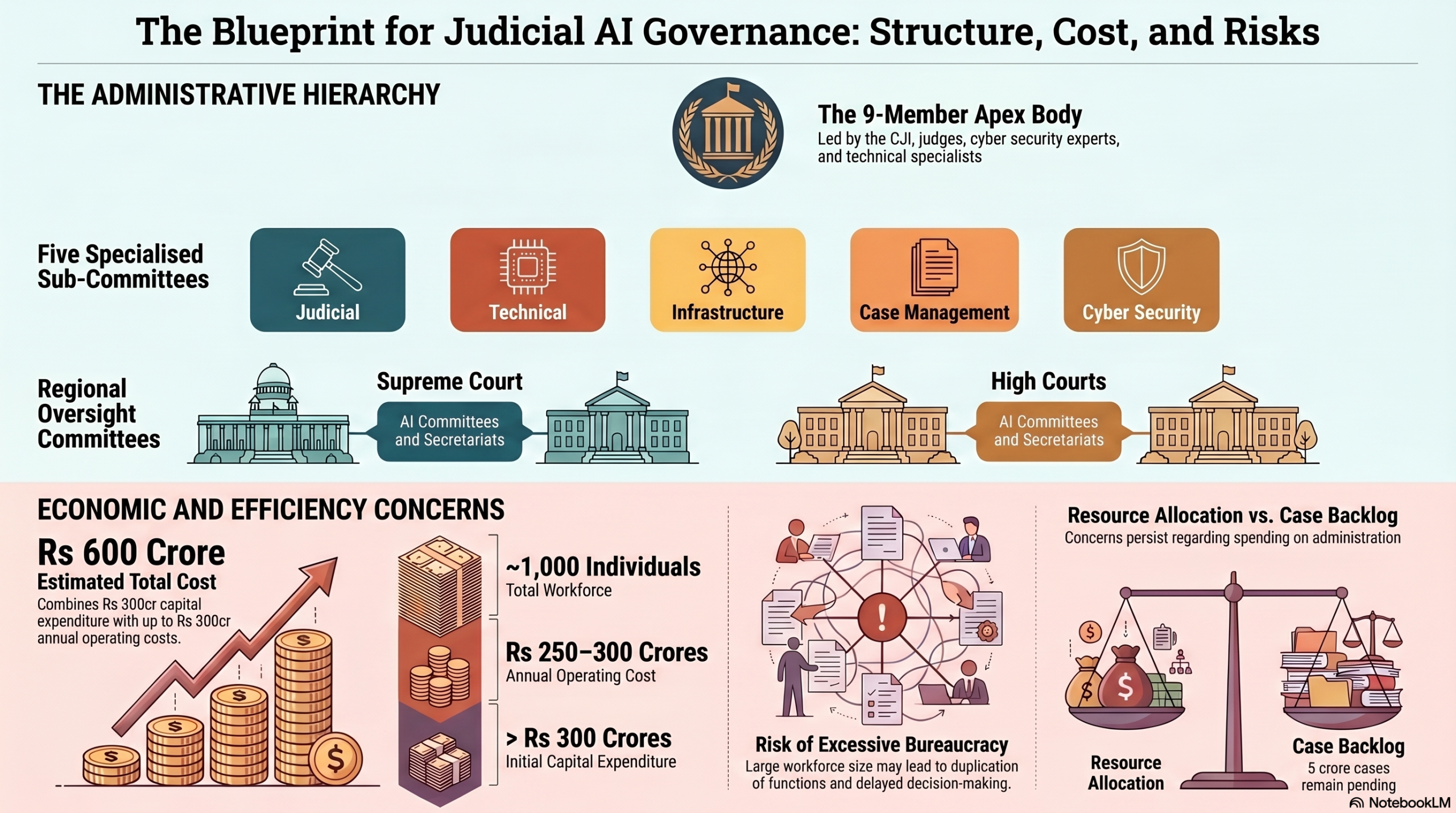
Firstly a full time permanent apex body is being constituted to regulate and promote innovation, integration, governance, oversight, standard-setting and policy development on Artificial Intelligence in judiciary. Though section 22 suggests that this will take care of bot “Innovation” and “Regulation” we can envisage that it will be mainly a regulatory body permitting innovation within limits.
The apex body will consist of 2 Judges of Supreme Court nominated by CJI one of whom will serve as the Chairman ex-officio.
Two more Chief justices of High Courts, would also be nominated by the CJI. An officer not below the rank of a Joint Secretary from MeitY would be an ex-officio member. One expert in Cyber Security and one expert in Finance would also be in the apex body. One (or more) advocates of standing and one member from an institution of national importance or any institution of repute would also be nominated by the CJI. Lastly the professor in charge of AI in National Judicial Academy Bhopal would also be in the committee. Additionally the Apex body can co-opt such other experts from Research institutions or academic bodies as it deems necessary. either on a case to case basis or standing basis with the permission of the CJI.
Thus the Apex body which is referred to as the “Appropriate Authority” would be a 9+ member committee with wide representation of judges, advocates and technical experts. The CJI will determine the terms of appointment of non-ex-officio members.
One of the functions of the Committee is to ensure that no AI system, whether autonomous AI agent or static predictive model or any AI Tool, is in violation of any of the provisions of the Constitution or any law for the time being in force and are in compliance with the operational safeguards;
The Committee will also ensure compliance of these regulations, liaise with MeitY, NIC etc, hear and recommend actions when grievances are raised or any other functions assigned.
It is obvious that CJI would be the driving force of the committee and will head the committee as the ex-officio chairman.
The apex body shall constitute five sub committees namely
(a) Judicial Committee; (b) Technical Committee;
(c) Committee on Infrastructure and Finance;
(d) Case and Data Management Committee; and
(e) Cyber Security Committee
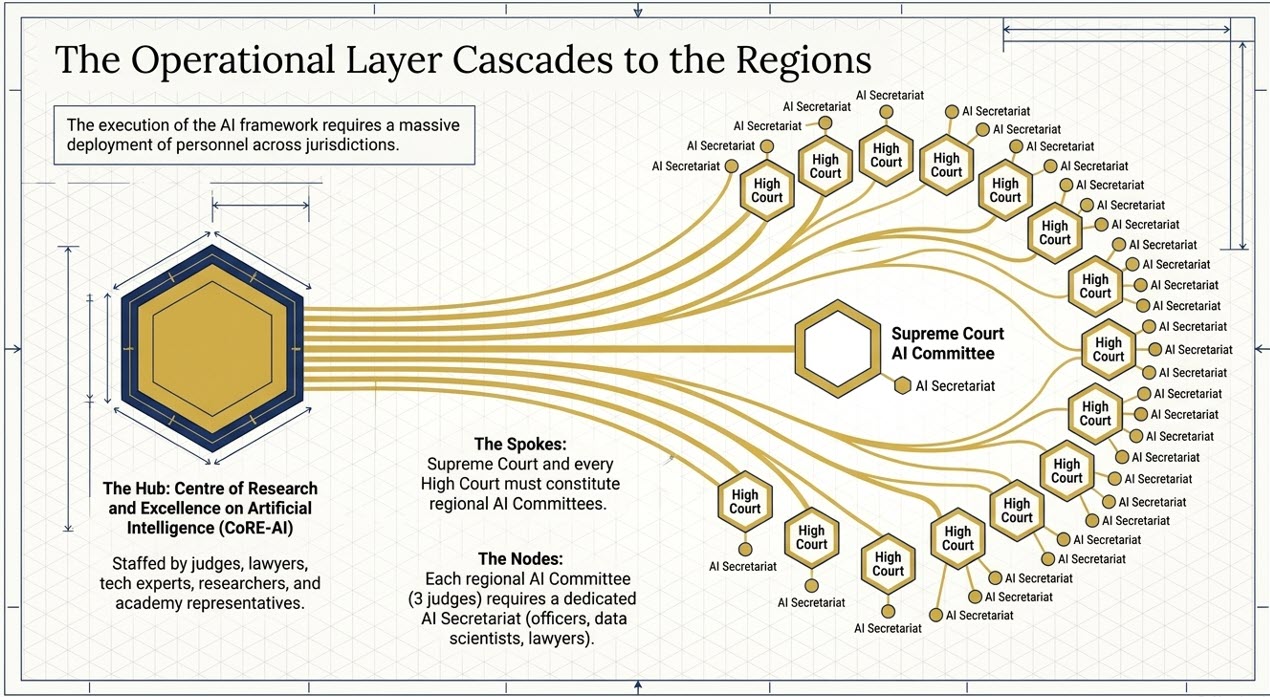
Supreme Court will also form a “Center of Research and excellence on Artificial Intelligence” (CoRE-AI) ), as an integrated body, having such number of experts in the fields of technology, law, and academia, as may be determined by the Apex Body, to provide research and legal compliance-related support to the Apex Body. This center will have experts who are Judges, lawyers, technical experts, academicians in the fields of AI and law, Senior and Distinguished Fellows from Think-tanks, post-doctoral researchers and representatives of the National Judicial Academy.
Additionally the Supreme Court and every High Court shall constitute AI Committees to oversee, regulate and facilitate the responsible adoption and governance of AI within its jurisdiction.
This AI Committee will consist of three judges and a senior member of the AI secretariat and such other members of the AI secretariat as the AI may invite and will monitor. Each such committee would be supported by an AI Secretariat.
The AI Secretariat shall consist of such a number of officers and experts in judicial administration, technology, data science and law, as may be determined by the AI Committee.
While the importance given to AI Governance can be appreciated, the number of Committees, Sub Committees and Secretariats may create a huge structure with increased cost of administration.
It appears that the system is being set up on a totally self dependent manner and hence all functions are being regulated directly under the CJI with multiple committees and employees. Officials of MeitY, NIC and CERT-In would be involved in relevant committees but will function under the CJI’s supervision.
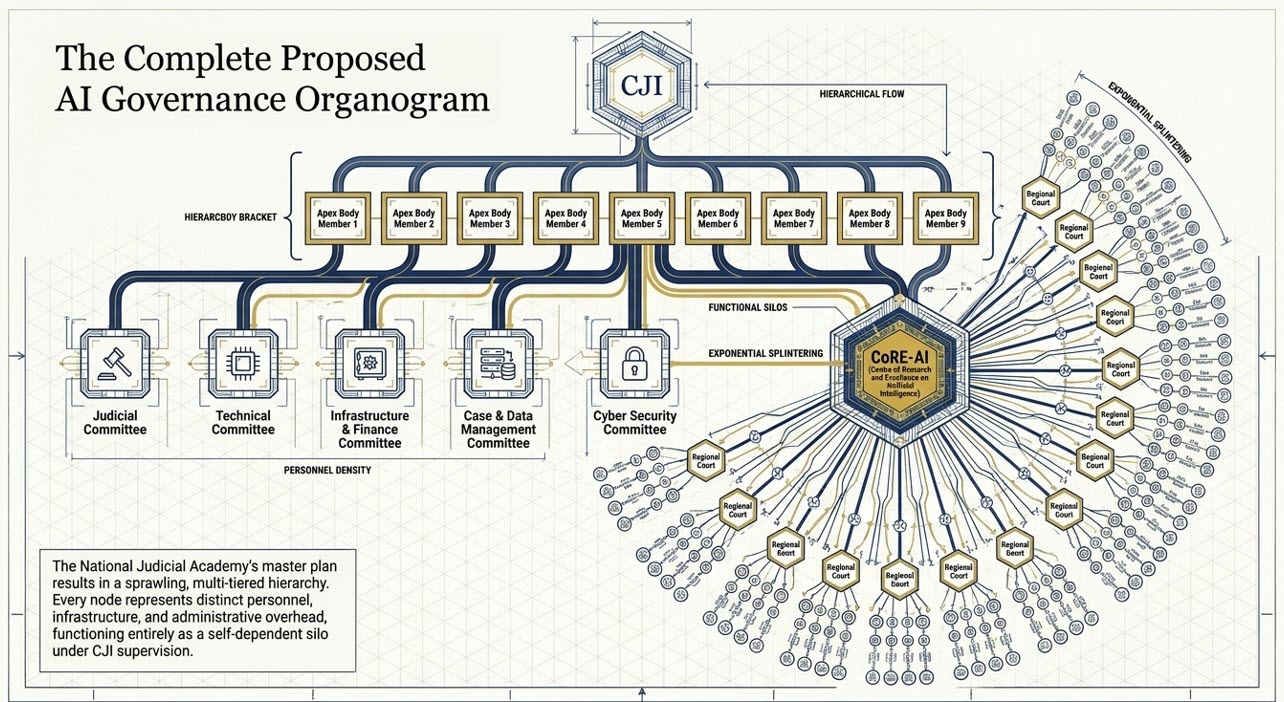
A rough estimate indicates that the entire paraphernalia consists of nearly 1000 individuals and a total operating cost of around Rs 250-300 crores per annum along with capital expenditure that may exceed another 300 crores.
There is a danger of excessive bureaucratization, over governance and duplication of functions which may delay the decision making process and create dysfunctional cross currents.
When 5 crore cases are pending, whether deploying such funds not for handling cases but for the administration requires re-thinking.
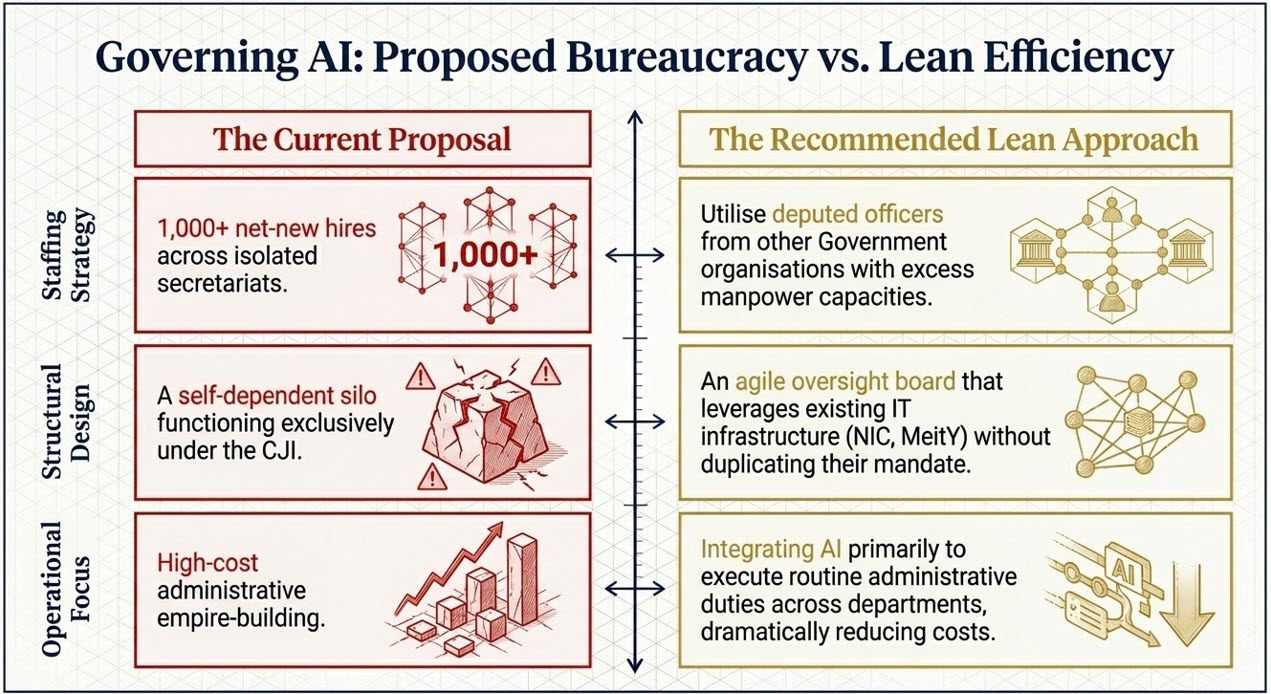
It appears that there is scope for substantial reduction of costs by better organization and using deputed officers from other Government organizations where there could be excess manpower capacities particularly since AI will be used for routine administrative duties in every department of the Government.
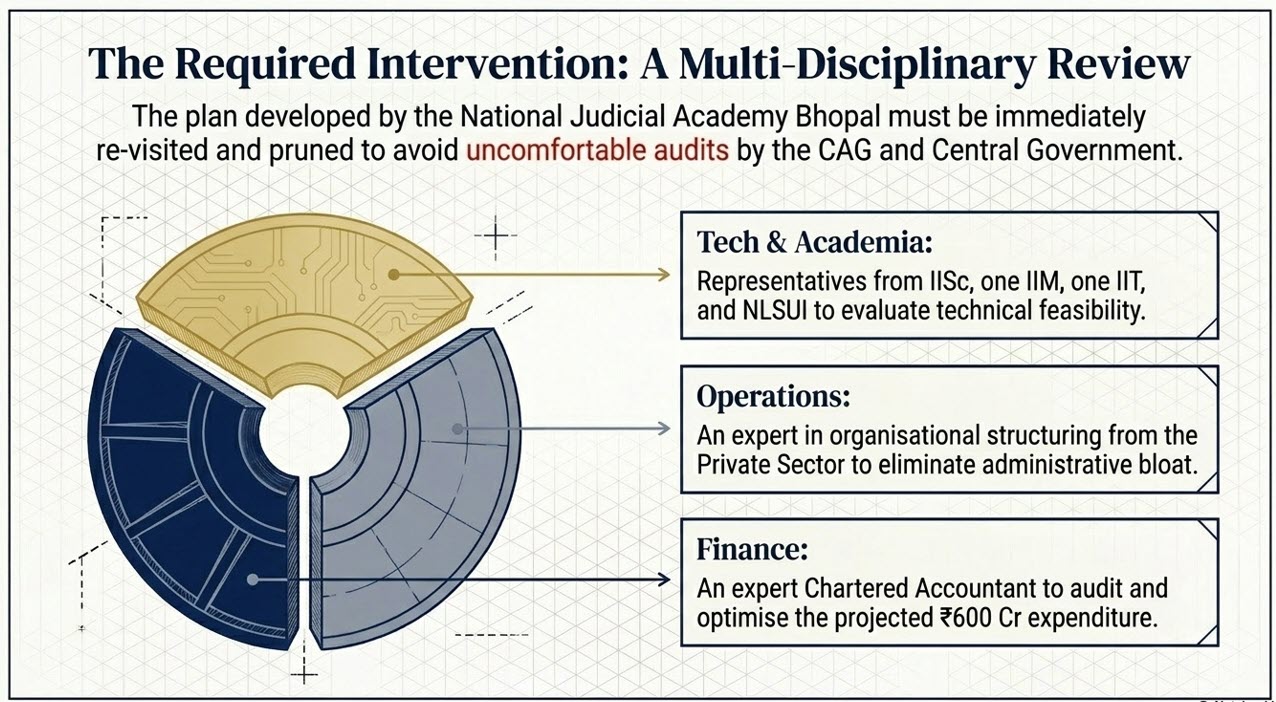
This plan appears to have been developed by the National Judicial Academy Bhopal and needs to be re-visited with the help of a review committee consisting of IISc, one IIM, one IIT, one NLSUI and an expert in organizational structuring from Private Sector and an expert Chartered Accountant. Without such pruning, there is a possibility that the Central Government and CAG may be uncomfortable.
Naavi