
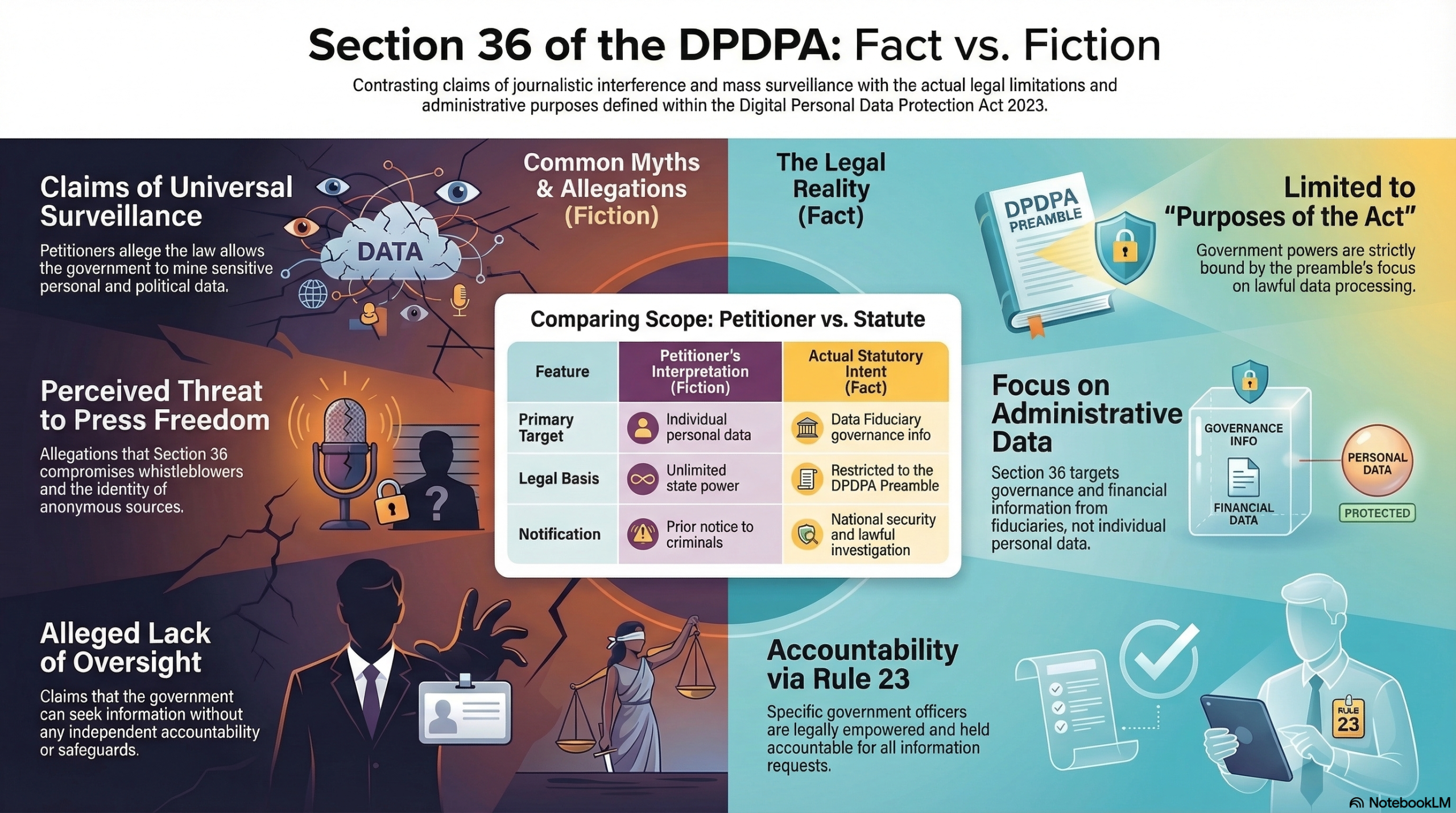
The Reporter’s Collective petition goes much beyond the “Dilution of RTI”, “No exemption for Journalistic work”, “Exemption to Government for enabling mass surveillance” and attacks Section 36 as an instrument of violation of the “Right to Freedom of Press”. This is an interesting but malicious argument meant to fool the Supreme Court which the Court should identify and penalize.
Section 36 of DPDPA is an innocuous single line section which states
36: Power to call for information.: The Central Government may, for the purposes of this Act, require the Board and any Data Fiduciary or intermediary to furnish such information as it may call for.
The Reporter’s collective has demonized this section through several pages of argument as an important ground to declare the Act as violative of the constituional right of the “Freedom of speech and expression of the journalist’s Private sources, whistle blowers and informants to the potential for compromise of their personal identity and personal data.”
Let us deeply analyze this contention that “Government being empowered to seek information from Data Fiduciaries” is curbing the sources of information of an investigative journalist and therefore violative of the “Freedom of Press”.
The contention must be appreciated for its ingenuity and linking the un-linkable. This is the creative mind of the PIL advocate at its best.
The arguments draw a parallel between “Extracting information by planting a Pegasus software without the knowledge of a potential informant of a journalist” in the Manohar Lal Sharma vs Union of India case, to the Government seeking information from a regulated entity. Again the Section 36 can be used only “For the purposes of the Act”. The purpose of the act as described in the Preamble and through the sections donot include digging of information of an investigative journalist.
Let us recall the preamble once again….DPDPA 2023 is an act to provide for the processing of digital personal data in a manner that recognizes both
a) the right of individuals to protect their personal data and
b) the need to process such personal data for lawful purposes and
c) for matters connected therewith or incidental thereto.
Hence Section 36 does not give any powers to the Government as claimed in the petition ..
i) which can reveal significant information about any person.
ii) which can be used to identifyotherwise anonymous metadata obtained by various means,
iii) which can also be used to identify anonymous online content obtained by various means.
iv) Can identify and reveal reveal intimate details about an individual’s life religious affiliations, political beliefs, sexual orientations, health concerns, or personal relationships.
v) lacks any oversight or accountability mechanism that independently authorizes the request for information from the Central Government. (petitioners forget that under Rule 23, different officers of the Government are specifically empowered and are accountable for seeking such information)
vi) empowers the Central Government to call for a broad category of information pertaining to information which is likely to “prejudicially affect the sovereignty and integrity of India or security of the State”, without sufficient procedural safeguards.
These contentions of the petitioner are not substantiated by any part of the law as proposed and are only an imagination of the petitioners.
The petitioner’s seem to think that for every administrative decision to be taken by the DPB or the Authorized official of the Government on the Data Fiduciary, an independent Court order is required. This is a suggestion to reduce the Supreme Court to the level of the Secretary of the MeitY.
The petitioner thinks that Under section 36, Government will be seeking information about an individual without consent. This is a known false statement since Section 36 is about seeking information about Governance, Financial, Administrative and other information from the Data Fiduciary and not seeking information from an individual or about an individual. If incidentally the Data Fiduciary needs to reveal any personal information of a data principal, then the data fiduciary is responsible for the use of legitimate basis for the disclosure or resist it in a Court of law.
The petitioner is childish and contends that the individual whose information may be revealed for national security reasons should be informed before hand that their information is being collected by the Government. It is utter foolishness to expect this and it appears that the petitioners are already preparing to represent the criminals whose information may be potentially revealed during a criminal investigation.
The petitioners of the Reporter’s Collective petition have proven beyond doubt that they have intentions of preventing whatever benefits this law may give to the society and exhibit a mindset to assist criminals through their “Own concept of Privacy as a tool to hide crimes”. In this perspective, they may consider DPDPA as a hindrance.
But we the real public of India donot agree with their views and donot consider them as representing the public of India.
Supreme Court should not only recognize these ulterior designs and reject the petition but penalize the petitioners with a substantial fine.
Naavi








Pingback: Second Summary of Articles on DPDPA Petitions | Naavi.org