Make in India to create IPR wealth

Speaking at the National Conference on Cyber Space Security at Bangalore today, Dr K.D.Nayak, DS & DG, DRDO highlighted the importance of “Make in India” concept from the point of view of the need to protect IPR. He recalled that the manufacturing cost of an Apple i-Phone which costs around US$ 650 in the retail market is only around US $ 200 and attributed the differential profit earned by Apple to the IPR developed by Apple. He therefore urged that while for security reasons we do recommend “Make in India” in cyber space, the benefit of IPR should also be taken into account and we should focus on “Design and Make in India” rather than only “Make in India”.

We fully endorse this view and wish that this is taken note by the policy makers in Delhi.

While it is interesting to note the collateral benefit of the IPR as evident in the Apple i-Phone case, it also indicates the darker side of the IPR law which is assisting in the exploitation of the consumer. The Apple’s profit of over 100% on its manufacturing cost should be considered as a “Usurious Profit” which is anti consumer.

IPR particularly the “Patent” is the main cause of increasing the cost of services despite increased use of IT in business.

We have seen this in the Banking segment in particular as well as in the E Governance sector where IT sneaked in as a means of economic and efficient delivery of services but over time increased the cost of services.

Now when we speak of security as well as cyber law compliance, many in the industry would only focus on the cost and load it on the consumers.

As the Government pursues the concept of “Digital India” and we the cyber security specialists pursue the need for security, we need to ensure that services donot become too expensive over a period of time creating an unrest in the society.

I would urge the Government to therefore keep an eye on how foreign companies manufacturing in India would load
their research expenses in the form of IPR. At the same time we need to increase the investment in Research several folds to ensure that a fair share of future IPR is held by Indian citizens.

I also urge the Government to ensure that the FDI policy in general should also include a clause that whatever is discovered/designed in India ultimately creates IPR value for the country.

Naavi
Posted in Cyber Law | Leave a comment

Tech Mahindra starts use of Digital Signatures for job offers

It was heartening to note that Tech Mahindra has reportedly started using digital signatures for sending out its job offers to counter the phishing mails sent in their name. (See Report Here).

This has been a continuing demand of the undersigned for last decade and I am happy to note that at least now one company has realised the importance of being Cyber Law Compliant.  We presume that this would be because of some enterprising and committed individual in the IS department who is different from others. We congratulate this anonymous IS professional for his initiative.

We may note that ICICI Bank was pulled up by the Adjudicator of Tamil Nadu in the phishing case in which ICICI Bank was ordered to pay compensation to their client Mr S.Umashankar who had suffered a wrongful loss on account of a phishing mail, for not using digital signatures on their mail communication to the clients. Banks have still not learnt their lessons since the lethargic judicial system of India supported by the lethargic bureaucracy is available to them to prolong litigations and harass their customers into submission in such cases. But we have faith in the adage “God Sees the Truth But Waits” and one day Banks will realize that they would be held liable for Phishing because they failed to use digital signatures on their mails as a continuing practice.

It was also reported (See report here) opening of emails with subjects such as “Salary Hikes for Government Employees” was a reason for a Pakistani firm stealing data from Government functionaries. If the Government had adopted the use of digital signatures for their internal communications, the possibility of such data thefts could have been reduced.

Having reiterated the need for the use of digital signatures by corporates as a part of the ITA 2008 compliance requirements in India and as a risk mitigation measure in general, it is also necessary to point out two other aspects that have a bearing on the use of digital signatures.

Firstly, the “Ponemon Institute’s 2015 Cost of Failed Trust Report” revealed that  most organizations believe the trust established by cryptographic keys and digital certificates, which they require for their businesses to operate, is in jeopardy. This study done across 2300 IT security professionals in Australia, France, Germany, UK and US, concludes that in the next two years attacks on keys and certificates are likely to increase and threaten the crypto systems. Security professionals look at the possibility of a “Crypto-apocalypse”, a scenario where standard algorithms of trust like RSA and SHA are compromised and exploited overnight. (Apocalypse=pralayaMtaka darshana/shruti/saakshaatkaara, in Sanskrit or Kannada)

In the light of this survey, we are in a situation where we need to ask “Are we in India ready to face the consequences of a Crypto apocalypse”?

My recent encounters with some of the certifying authorities indicate that even those who are using digital signatures in India are doing so in an extremely insecure manner and the CCA is itself grossly negligent of turning a blind eye to the situation of organized non compliance of ITA 208 by certifying authorities.

Wish CCA responds to this post.

Naavi

Posted in ITA 2008 | Leave a comment

Digi Locker Beta Release

Government has opened the beta version of the Digital Locker operated by CDAC and UIDAI which provides 10MB free storage space for every Aadhar number holder. It envisages that members can upload their ID documents and share it with other Government agencies if required.

The service is available at   http://digilocker.gov.in. It can also be accessed through http://digitallocker.gov.in and http://elocker.gov.in.

The site carries a digital certificate from an Indian Certifying Authority unlike many other web sites which are using certificates issued by verisign which is not licensed in India. However it is surprising to note that instead of using a digital certificate issued by the Government owned NIC, the site uses the certificate from (n)code solutions which is a private sector certifying authority. Also, some of the practices used by (n)code solutions for issue of digital certificates to public is not in accordance with the legal procedures suggested under ITA 2008. It is therefore surprising that the project has preferred to use their services instead of NIC or other more Cyber Law Compliant Certifying Authorities.

At the time of account creation and for certain other operations, the site uses OTP as a verification mechanism. It appears that an “e-sign” procedure is envisaged for users to individually authenticate the documents. But this is not yet working properly at present. It is also not clear what is meant by e-sign in this context.

The documents would be made available to designated agencies of the Government. Users can also send the document to another person through email.

While the concept of making available a free digital document storing place is welcome it is necessary to note that the site is short in the implementation of ITA 2008 compliance measures.

The website is silent on the issue of storage of information and it is unlikely to be in an encrypted state. We draw the attention of readers to my immediate previous post about the data breach in Anthem Inc, USA and the consequences. We are already aware that the Aadhar data base has been compromised in parts many times and lakhs of aadhar records would be available with cyber criminals as well as the enemy states of India. Now if the linked information is also leaked, it is a goldmine for terrorists in Pakistan or ISIS as well as countries like China who are preparing for Cyber space domination.

Government of India may be unaware of the risks that it is undertaking in this project and Modi Government should be prepared for a huge embarrassment at some time in future.

Employers should also be ready for a completely faked employee IDs with fake marks cards etc which may completely compromise their background verification systems. This can enable more Mehdi’s to find employment in critical sector and compromise the national security interests.

We hope the authorities will take a deep breath and review the security of the system before proceeding further.

Naavi

Posted in Cyber Crime, Cyber Law, ITA 2008 | 1 Comment

Multi Billion Dollar Catastrophe…

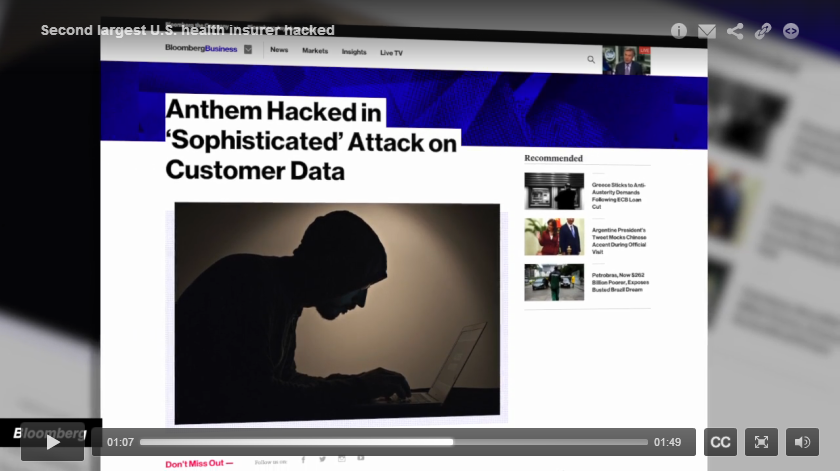
anthem_video

On January 29, 2015, Anthem Inc, a Health Insurance provider in US (second largest in US) reported a discovery of a Cyber Attack in which it is estimated that about 78.80 million health records have been compromised. (Refer here). The incident has sparked many law suits and is expected to impact the information security practices in US and elsewhere. (See report in Fortune)

The data that were accessed by hackers was not encrypted and contained identity details such as the social security numbers. This is a violation of the security requirements under HIPAA-HITECH Act and attracts civil penalty from the department of Health and Human Services (HHS).

 According to the company’s admission, hackers gained access to Anthem’s data by stealing the network credentials of at least five employees with high-level IT access. The data is believed to have been extracted over a period of 6 to 8 weeks during which the attack went undetected. The company claims that the attack was “Sophisticated” but only the investigations will reveal if it was really a sophisticated attack or a simple phishing attack.

This data breach may be the largest in terms of the financial implications on an organization. The company is said to have an insurance cover of US$ 100 million but the claims under this case may far exceed this limit. This could also be a big set back for the Cyber Insurance industry. The black market rate for health data in US is estimated to be around US 470 per record (See this article). The value of the data lost at Anthem in the black market is therefore around US$ 37.6 billion or Rs 2,33,000 crores. The value in the black market for a data is normally 5 to 10% of the potential benefit that can be derived from the data by a buyer. Hence the estimated gross value of the data lost in terms of the potential loss to consumers could be of the order of US$376 billion. (Also see here)

Now Anthem is focusing on its responsibilities under HIPAA-HITECH Act to assist the affected persons to protect themselves from the consequences of identity theft by providing a two year protection service from All Clear ID. (Refer here)Individually the cost of such service is around US$14.95 per month and for the 78.8 million IDs to be protected the total potential cost is Us $28 billion. Of course Anthem may get a much cheaper bulk rate. But the cost is still likely to be of the order of US $ 3 billion. This is besides the cost of sending data breach notices to 78.8 million people by US first class mail.

The net impact of this data breach on the Health Insurance industry, the Cyber Crime Insurance industry, as well as the status of HIPAA implementation across US (extended to Business Associates in India) are likely to be enormous. It will shake the whole industry and perhaps bring in several lasting changes in industry practices.

In the meantime, Anthem has also attracted another controversy by refusing to allow the US regulator the “Office of Inspector General” (OIG) to conduct a vulnerability scan of their systems citing their corporate policy that no external audit is permitted. (Refer here)

The Office of Personnel Management of  OIG  oversees the Federal Employee Health Benefits Program and in the course of such supervision  performs a variety of audits on health insurers that provide health plans to federal employees. Though it is a regulator of sorts, it is not having the same powers available to the HHS which is the regulator under HIPAA which has the powers of audit and imposition of penalty. The powers of the OIG has to be derived from a contract which Anthem believes are non existent.

While at first glance this attitude of Anthem appears to be self defeating from a PR angle, it is likely to establish the primacy of HHS as the sole regulator of Health data breach and resist an attempt by multiple agencies to fish in troubled waters. (Also see here).

Anthem attack itself has resulted from Phishing and now the incident itself has become a source for many other scams involving phishing e-mails offering various services. The collateral damage of this fraud can therefore go beyond the Health Care data breach.  Already suspicions are being aired about the hacking having emanated from China (See here). If these rumors are confirmed the breach may get a “Cyber War” tag similar to the recent attack on Sony attributed to North Korea.

The incident therefore has many dimensions and security professionals need to keep a watch on the developments.

End of the day one wonders…could a better “data encryption under storage” could have prevented this multi-billion dollar catastrophe?

Naavi

hipaa_apnacourse1

Posted in Cyber Law, HIPAA, ITA 2008 | Leave a comment

PMO finds a Chief of Cyber Security


It is reported (Refer article in ET) that Dr Gulshan Rai who has been a veteran in Cyber Security and part of MCIT for a long time has been drafted by the PMO as head of Cyber Security.

In the recent days, PM has been expressing some concern on Cyber Security and there was no better person to take this forward. In the Corporate world, we say that a designation/appointment of a person as CISO is a significant development in the road to Information Security implementation. Similarly this appointment is a significant step to demonstrate the commitment of the Government to address Cyber Security Issues.

We take this opportunity to congratulate Dr Gulshan Rai and wish him all the best. We hope necessary support would be made available by the Government to Dr Rai to ensure that his mission would be successful.

At the same time we need to remind that Dr Gulshan Rai was the Head of Department overseeing the Cyber Appellate Tribunal (CAT) which is still crying for appointment of a Chair Person. Our repeated requests to Mr Ravi Shankar Prasad as well as the PMO has not elicited any response.

Since Dr Rai is fully aware of the past issues involved in this aspect, we trust that CAT would soon get activated.

During the previous time when CAT was active, there was a move to set up a bench of CAT in Bangalore.

I request Dr Rai to take up this suggestion once again so that litigants from South India need not travel to Delhi every time for hearings.

I also draw the attention of Mr Siddaramaiah, the honourable Chief Minister of Karnataka with a request to take up the issue to the logical end.

Naavi

apna_ad_nov24

Posted in Cyber Law | Leave a comment

Monitoring of Employee Internet Activity

After the recent incidents involving corporate employees engaging in terrorist activities, there is an increasing necessity for companies to monitor the employee’s internet activities.

The Hyderabad police have reportedly advised companies to monitor the social media activities of their employees as a part of anti terrorist measures.

From the Information Security point of view it therefore becomes mandatory for companies to put in place appropriate technology measures to monitor the activities of their employees at least when they use the IT assets of the company.

Further the HR department needs to device methods to monitor the behavior of their employees that indicates any pattern of activities that indicate radical leanings of the employees towards ideologies that may nurture terrorism.

This is the new challenge to CISOs following the Mehdi Masroor incident in Bangalore.

Naavi

Posted in Cyber Law | Leave a comment