Election Commission and IIT-Madras working on E-Voting on a wrong platform

According to the news reports that are circulating, it is reported that the Chief Election Commissioner Mr Sunil Arora in an interaction with the IPS probationers at the SVP National Police Academy, Hyderabad has stated that 

“Election Commission is working with IIT-Madras on using Blockchain Technology for remote voting”.

This statement raises doubts on what exactly is in the minds of the EC and how IIT-Madras scientists are suggesting Block Chain technology for this purpose.

Block Chain technology per-se is a technology of “Authentication” of a transaction which is published to a large number of authentication agents, and the majority acknowledgement of the transaction is taken as a “Deemed Authentication”.

We donot know if the EC is referring to Block Chain technology in this sense or just referring to a “Secure Network” based transaction and wrongly labeling it as Block Chain technology.

In a connected statement, Mr Sandeep Saxena, Deputy Election Commissioner has stated that they will be using a “Controlled Environment”, “White listed IP devices” “Dedicated Internet lines” “Using biometric devices and web camera.”etc.

It is clear that Mr Saxena is speaking of a secure network and this is not the classical “Block Chain Technology”.

Instead of running behind a fad called “Block Chain Technology”, Election Commission should consider use of “Digital Signature” and “E Sign” to let voters vote by remote log in and this is acceptable in Indian law as of now. This can be supplemented with data pseudonymization to achieve the objective.

If the secured network technology as is suggested by Saxena is to be used, the process will have to be Section 65B (IEA) certified and otherwise it would not be legally admissible.

Further, the remote voting based on “Block Chain” technology if attempted would be an invitation for disaster similar to what happened in US elections this year where unaccounted postal ballots caused a disruption to the election system.

If Block Chain technology is used say even for validation of a voter, it has to be based on a confirmation received by a majority of owners of a block chain node either public or private. This network can be easily manipulated to create false IDs and fake Votes.

Hence “Block Chain” technology of the way we understand now cannot be used in the E Voting system. If the EC and IIT Madras have some other technology in mind, they should stop referring it to as “Block Chain Technology” as if it would increase the TRP of the statement.

I look forward to a clarification from the EC and IIT Madras to clarify what exactly they plan to do, why they donot want to use the existing digital signature and E Sign framework and why they are using the terminology of “Block Chain” in this context.

Additional Information Received

As per additional information available, the EC has clarified as follows:

When the vote is cast, the ballot will be securely encrypted and a blockchain hashtag generated. This hashtag notification will be sent to various stakeholders, in this case the candidates and political parties,” the official said.

The encrypted remote votes so cast will once again be validated at the pre-counting stage to ensure that they have neither been decrypted nor tampered with or replaced.

“Suppose there is a Lok Sabha election and a Chennai voter is in Delhi, instead of returning to vote in his or her constituency or missing out on voting, the voter can reach a pre-designated spot set up by the EC, say in Connaught Place, in a particular time window and can cast his vote,” Saxena had said.

EC has said such voters may have to apply in advance to their returning officers to exercise the option.

With this clarification, what the EC’s remote voting system means is  that a copy of the “Vote” would be hashed and the hash value would be sent to the stake holders and the EC. Hash tags of a vote to a given candidate will all be identical and therefore such votes can be segregated into votes for different candidates. This is like the physical ballot paper being put in different boxes. (In case the vote is encrypted before hashing, the confidentiality may be maintained. But the need for keeping the political parties informed is not clear)

The Name “Block Chain Technology” for this is not very appropriate.

Also since votes are cast in specific voting booths, the booth master has to conduct a KYC and the booth agents of all the political parties will be present in the booth. The system only means that instead of one EVM per constituency, the voter can use a virtual copy of EVM of any constituency in the booth and he can exercise his vote.

The block chain concept is only involved in the fact that if there are 5 political parties in the election, then all remote votes would be informed to all the five political parties as and when the vote is cast. If it is sent as soon as the vote is cast, as indicated by the EC, the political parties would come to know the vote cast immediately.

Though the parties may not know who has cast the vote, the number of votes polled for a political party will be known. This would amount to advance information on the polling trend. In case the votes are stored and the forward is initiated only on the counting day, then it would be similar to the current practice of counting postal ballots before the counting of other votes.

A question however arises that if it is possible to send the postal vote immediately in hash form to the parties, then why not introduce the same system for the normal EVM votes also which prints out the VVPAT slips. At the same time, the hash value can be sent to the parties.

However this would create a law and order situation as the losing party would immediately disturb the election process.

If such advance information can harm the normal voting system, then it is obvious that the suggested system is also wrong.

On the other hand, I recall that I had suggested a system of “Cyber Law Compliant EVM system” through this website sometime around 2000. (Refer here). Even a prototype was suggested for development by BEL. However at that time the technology of touch sensitive screens was expensive and the system was perhaps not commercially feasible. But now VVPAT system is in place and it is working well enough.

What can be done:

The postal ballot system can be introduced in a different manner as follows.

  1. Authentication of the voter has to be based on e-sign .
  2. Casting of vote is done by a virtual EVM created on the fly based on the constituency to which the voter is attached.
  3. The Virtual EVM would be displayed on a touch screen and when the voting button is pressed, the system should create a voting symbol on the screen (as if a rubber stamp has been put on a printed ballot), capture the screen image, calculate the hash value and store the hash value in a printer.
  4. Just like a serial number being present on the voter slip which is entered in the physical election booth under a serial number which can be linked to the specified VVPAT, it may be possible to establish a link to the digital signature with the actual vote cast through a serial number. To ensure privacy there may be pseudonymization of the digital signature record with the pseudonymization table being kept with an official other than the one who has control to the Virtual EVM.
  5. The Virtual EVM should be counted just like the other EVMs on the day of the counting but at one central place.
    1. At this time, the votes should be verified with the hash value once again to rule out any corruption or manipulation from the time of voting and the time of counting and then sent to the respective counting booth of the constituency through a digitally signed communication from the central counting booth to the constituency counting booth.
    2. Then it can be merged with the counting at that booth.
    3. The Ujvala-Bellur  e-document audit system can be used for the verification of the votes.

I hope this system can be given effect to.


Naavi



Posted in Cyber Law | Leave a comment

Naavi on Cyberlaw

Posted in Cyber Law | Leave a comment

Is there a strategy behind the silence for Mr Modi and Shah not banning Bitcoins…yet?

Naavi has been singlehandedly fighting against legalization of Bitcoins in India. Bitcoin is a poison that can corrupt any body. Those who already have a stake in Bitcoins will always fight for legalization of the Crypto currency system. Some of them are tech experts and even industry giants. But that does not mean that their views are good for the country.

Rihanna may be a celebrity singer. But her views on farm laws donot deserve to be heard.

Similarly the views of industry giants which the PR machinery of Bitcoin industry are promoting need to be dumped with contempt it deserves.

In the midst of planted articles in the media including Economic Times and Business standard, it was refreshing to see an article today in Financial express titled “Is it smart to invest in Cryptocurrency right now?”  by Mr Varun Malhotra, Director & Founder of Financial Services (EIFS).

Before Mr Nandan Nilakeni joined the bandwagon of Bitcoin supporters, Elon Musk of Telsa was a vocal supporter. It is now reported that Mr Elon Musk invested $1.5 billion in Bitcoin recently and therefore there is no surprise that he supports Bitcoin.

On the otherhand, Mr Warren Buffet has taken a stand “Cryptocurrencies basically have no value and they don’t produce anything…In terms of value: zero. I don’t have any cryptocurrency and I never will,”

It does not take rocket science to understand why Cryptos are being encouraged by people who want to hold digital black wealth. Bureaucrats, Politicians and even Judges in India or elsewhere may still favour Bitcoins but we know why they may have a soft corner for the Crypto currency. It is the greatest technology tool for Cyber Criminals and anti social elements including drug peddlers, illegal weapon dealers, cyber terrorists etc.

But why is it that the Indian Government is still hesitant to ban Crypto currencies? Why is that the Cabinet of Mr Narendra Modi has not passed the Bill? is an enigma.

Has it got anything to do with elections in West Bengal? or Kerala? Are Modi and Shah not courageous enough to take on the digital black wealth holders before the elections?…is a question we should pose to the BJP as well as the RSS.

I have sent many requests even to RSS and its known ideologues regarding the Bitcoin ban and even they seem to keep tight lipped.

Corruption has a wide footprint. We never know how powerful it can be. Let us see if there is a strategy behind this silence.

Naavi

Posted in Cyber Law | Leave a comment

Support to Bitcoins is another challenge on the sovereignty of India

Recently, we have seen how Twitter challenged the sovereignty of India by refusing to abide by the lawful notices issued by the Government on removal of content which were false, some of them posted under fake accounts and attempting to promote violence and rioting in India. WhatsApp also has been resisting the directions from the Government to assist them in law enforcement issues when the platform is used for promoting communal disharmony and riots.

The Government after hesitating to take a firm action for several years, finally came down with a firm hand with the Intermediary and Social Media Guidelines issued on February 25th which addresses both the Twitter arrogance and WhatsApp reluctance.

However, true to the nature of Indian democracy, the Supreme Court has now stepped in to take over the executive functions of the Government and determine whether the Gazette notifications should be first approved by the Court.

Now that Mr Ravi Shankar Prasad joining hands with Mr Prakash Javdekar together exhibited some courage which was missing with the Government for a long time, Mrs Nirmala Sitharaman on her own is still in the zone of hesitancy when it comes to the decision on Crypto Currencies. Mrs Sitharaman is presently concerned with the passage of her bill and perhaps has no energy to open another front of conflict on Bit Coins particularly when many in the bureacracy and political circles are themselves wedded to Bitcoins as the “Currency of the Corrupt”.

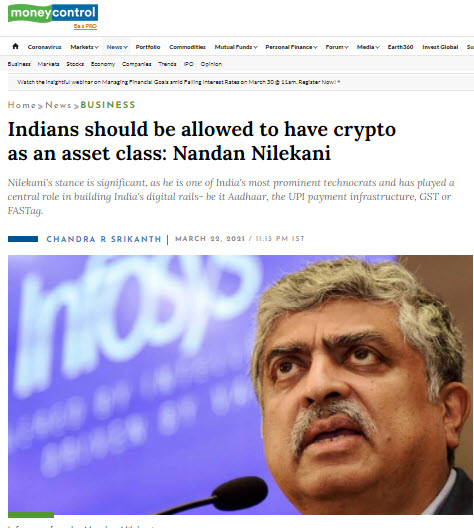
One of the first disappointments for the undersigned was when Mr Rajeev Chandrashekar met the Crypto lobby in Bangalore and gave a moral support. Now Mr Nandan Nilekeni

the Executive Chairman of Infosys has been roped in by the Bitcoin lobby to oppose the move of the Government to introduce a bill to ban Crypto Currencies.

Mr Nandan was once a blue eyed boy of Sonia Congress and even stood for election in Congress ticket in the constituency presently represented by Mr Tejasvi Surya. But his pet tech project namely the Aadhaar was actually given life by the Narendra Modi Government and not the UPA Government which he supported.

After Mr Nandan went back to the corporate world he had consciously avoided  controversies. However, by entering a debate on Crypto Currencies which the Government and the RBI has an inclination to ban, he seems to have strayed back into the domain of controversy.

I hereby call upon him to clarify the context in which he made the statement

“We need to look at how it will help Indians, how MSMEs can access capital using Bitcoins. 

He was in a conversation with Balaji Srinivasan an investor who appears to have expressed a view

“India should champion decentralized cryptocurrencies like Bitcoin and Ethereum to safeguard national security, prevent de-platforming and hasten India’s development as a global power”

According to the report in Money Control which is part of the larger PR exercise with articles expressing similar sentiments in Economic Times, Business Standard etc., there are 75 lakh investors from India and 10000 to 15000 crore worth Crypto currencies in the hands of Indians.

We would like to read this as 75 lakh tax evaders with Rs 10000 to 15000 crores of digital black money in their hands which needs to be brought into the main stream economy.

The Crypto exchange leaders are keeping up a bold face and are even stating that the rumour of banning is actually increasing the investments in crypto currencies. If we believe this statement, there is a scramble for moving the Indian official currency holdings to foreign destinations.

Mr Nandan and others are trying to take cover of their support to “Digital Money Laundering” by holding out the “Block Chain” technology as a great innovation. Even if we accept that Block Chain is a good technology, it does not mean that it should be encouraged to host digital black money.

I would like Mr Nandan and Mr Balaji to clarify with all their economic wisdom, how they consider that shifting  Currency holdings of Indian Citizens to a decentralized form of currency namely “Bitcoin” would not starve the economy of legit currency holdings and not  create a chaotic level of disruption that will destroy the country.

In order to preserve their vested business interests, Mr Nandan and Balaji should not take a view that is inimical to the national sovereignty over currency. We are today not under a “Nityananda regime in Kailash” and if the world order should remain in tact, such support to Bitcoins by industry giants need to be condemned.

We are aware that Mrs Nirmal Sitharaman is too soft to call a spade a spade and would like to beat around the bush to be apologetic. But truth has to be called out.

Bitcon is evil. All connected crypto currencies to which Bitcoin is convertible are by association also evil. They are a challenge to the Indian sovereignty.

We must therefore be bold enough to say no to Bitcoin everytime…

Naavi


Posted in Cyber Law | Leave a comment

Why is Privacybee.com email objectionable?

I refer to my previous articles related to an e-mail from a company with a domain name privacybee.com registered at  Seattle P O Box address in the state of Washington.

The company is not a resident company in California nor in EU region. But it quotes privacy laws such as

“Section 1798.105 of CCPA (SB-1121), Article 17 of GDPR, Nevada SB-220, New Hampshire HB 1680-FN, Washington Privacy SB-5376, Illinois DTPA SB2330, New York S5462, Hawaii SB 418, North Dakota HB 1485, Massachusetts S-120, Maryland SB 613, Texas Privacy Protection Act HB 4390, or other applicable right-to-be-forgotten legislation.”

to state that if its request to “Delete” a certain personal information is not adhered to,

Privacy Bee, are reserving the right to take legal action against ..and to lodge a complaint with the responsible supervisory authority.

For people who know the privacy laws it is a threat that GDPR supervisory authority may fine upto 4% of your turnover or the AG of California may impose a fine of at least $7500/.

This is a harassment of the mail recipient.

We can also note that the company quotes a “Power of attorney” which has no recognition and uses e-mail address and a name without any verification such as a digital certificate etc,

There are hyperlinks to be clicked for further information which will install many cookies and there is no guarantee that they are not malware in themselves.

Even if you visit their web page several javascripts may become active and whether they have any malicious effect is to be checked.

The Privacy policy of privacybee.com itself may not be fully  compliant with CCPA nor GDPR and certainly not the laws of India as applicable now for such websites.

This company is using the cover of Privacy laws to scare Indian companies and encouraging Indians to part with their e-mail address for a “Scan” which itself could be a way of collecting personal information without accountability.

There is a need for the Indian industry to study the business model of this company and prevent it from illegal collection of personal data of Indians.

We may re-iterate that PDPB 2019 expects such agencies to register themselves as “Consent Manager” with the DPA and subject itself to the discipline of a “Data Fiduciary” which includes submission of a “Privacy By Design” policy with more details of the processes used by the company to handle the PII of Indians.

Further there is a transfer of information out of India and even under the current ITA 2000/8 without considering the due diligence of PDPB 2019, there are “Reasonable Security Practices” which the company may not be following.

I wish CERT-In conducts an enquiry of such companies who are like “Ambulance chasers” and discredit the Privacy Regulations meant to protect the genuine victims of identity theft and privacy infringement.

I request every professional to think if they receive the kind of email referred to in my previous article how would they respond.

Since compliance to the request would mean providing an assurance that

“We donot have the personal details of the data subject and/or we have deleted all copies of information related to this data subject from all the resources of our company and our dub contractors”

each of the professionals may also consider what would be the cost of attempting to address this speculative query which is unverified and not backed by legal authority

Naavi


Posted in Cyber Law | Leave a comment

Complaint filed against Privacybee.com by Naavi

The undersigned had reported the activity of Privacybee.com discussed in the following two articles:

India does not allow PrivacyBee.com type of extortion companies to flourish
“Privacy Bee” stings…

As anticipated, it appears that several other companies in India have received the spam e-mail  containing a Cyber Threat and potential attempt at Cyber Extortion.

Naavi.org has therefore raised a complaint with the Attorney General California and the FTC, USA to stop this illegal activity.

We have also endorsed the copy of the complaint to the Secretary DIT and CERT-IN besides some of the prominent MPs as well as the NASSCOM. Hope it would be followed up by them in the interest of the Indian industry.
Copy of the letter is given below:

Vijayashankar Nagaraja Rao
Netizen Activist and Privacy Consultant
No 37, Ujvala, 20th Main, BSK First Stage
Bangalore 560050
www.naavi.org: naavi@naavi.org

16th March 2021

To

Respected Mr Xavier Becerra

The Attorney General, State of California
Office of the Attorney General
455 Golden Gate Avenue, Suite 11000
San Francisco, CA 94102-7004

Through: email: AGelectronicservice@doj.ca.gov.

Subject: Complaint of Fraud and attempted extortion on Privacybee.com

Dear Sir

I am a Netizen Activist rom India and founder of www.naavi.org. I have recently come across a company operating from the website www.privacybee.com which is spamming and threatening many Indian companies in the name of certain individuals who claim to have rights under the CCPA demanding deletion of personal data without legal right to do so.

This company is liable under the Indian law for committing an attempt at cyber extortion.

However, since the Company is quoting both CCPA and is a resident of USA, I have brought to your notice that your office should conduct an enquiry on the business model of the company and their modus operandi.

Our general observation indicates that the company is like many fraudulent companies which try to sell anti malware software by falsely claiming that the user’s computer is infected.

If your office does not take action against this company, it would appear as if it has the support of your office for committing this Cyber Crime.

Kindly investigate and also file a complaint from your side with the FTC to prevent the company to continue indulging in its extortion racket.

I am enclosing a typical spam mail being sent by this company to the Indian companies.

I am looking forward to an early response from your end and I am also endorsing the copy of this letter to the regulatory authorities in India.

Since your website does not contain proper e-mail contact and the form provided is meant only for US residents, I am sending this communication through the email. If US resident companies are using CCPA as an excuse to send extortion and spam emails to residents of other countries, it is necessary that your office take the responsibility to atleast receive complaints from outside USA and try to redress the grievances.

Regards

Thanking you

Digitally Signed

Yours faithfully


 Attachment:

A Typical Extortion E Mail from Privacybee.com

From: Privacy Bee
Sent: .. M.. 2021 ..:..
To: DPO <>
Subject: Urgent Followup: Legal Request for Data Deletion and Opt-Out of Resale [Request ID: …..]

Concerns: ….

Request ID: ….
Signed Power of Attorney: Yes
Request Date: ….
Respond At: https://app.privacybee.com/request/

To Data Protection Officer or Legal Counsel:

I am hereby submitting a follow-up to a personal data request pursuant to Section 1798.105 of CCPA (SB-1121), Article 17 of GDPR, Nevada SB-220, New Hampshire HB 1680-FN, Washington Privacy SB-5376, Illinois DTPA SB2330, New York S5462, Hawaii SB 418, North Dakota HB 1485, Massachusetts S-120, Maryland SB 613, Texas Privacy Protection Act HB 4390, or other applicable right-to-be-forgotten legislation. If you feel my data is exempt from privacy legislation for any reason, I’m still asking you to respect my wishes regardless, as I believe privacy is a universal human right and I’m hopeful the integrity of your organization will honor my request with or without legal requisite.

The initial request was sent …. …….. and I still have not received a response that my request has been fulfilled.  This is a reminder that you only have 5 days left to respond!

Specifically for …..:
– Data Deletion: I hereby request the immediate and complete purging of any and all information your company has on me including but not limited to: user accounts, marketing data, transaction data, behavioral data, social data, CRM records, or absolutely anything that that contains my personal information.
– No Dissemination: if any information is being or has been disclosed, resold, licensed, rented, or otherwise disseminated by your company to third parties, I hereby request to opt-out of that data sharing, and request you communicate this request for opt-out and deletion to those entities as well.

If I have given consent to the processing of my personal data (e.g. according to Article 6(1) or Article 9(2) GDPR, or other applicable legislation), I am hereby withdrawing said consent. In addition, I am objecting to the processing of personal data concerning me (which includes profiling).

As I’m legally permitted, please confirm your compliance of my request without undue delay and in any event within one month of receipt of this request.

I am including the following information necessary to identify me:

Name: ….
Primary Email: ..
If you require additional information to resolve my identity, to view my signed Power of Attorney authorizing this request, or to respond to this request, please visit: https://app.privacybee.com/request/

You can also find my full privacy preferences in relation to .. by visiting the previous link.

If you do not answer my request within the stated period, I and my legal privacy advocate, Privacy Bee, are reserving the right to take legal action against ..and to lodge a complaint with the responsible supervisory authority.

Thank you.

Posted in Cyber Law | 7 Comments