Educational Institutions in India are a special sector of the society where DPDPA Compliance poses some unique challenges.
Some of the essential requirements of a DGPSI-Education framework are presented here for discussion.
Institutional hierarchy and the Super Data Fiduciary layer.
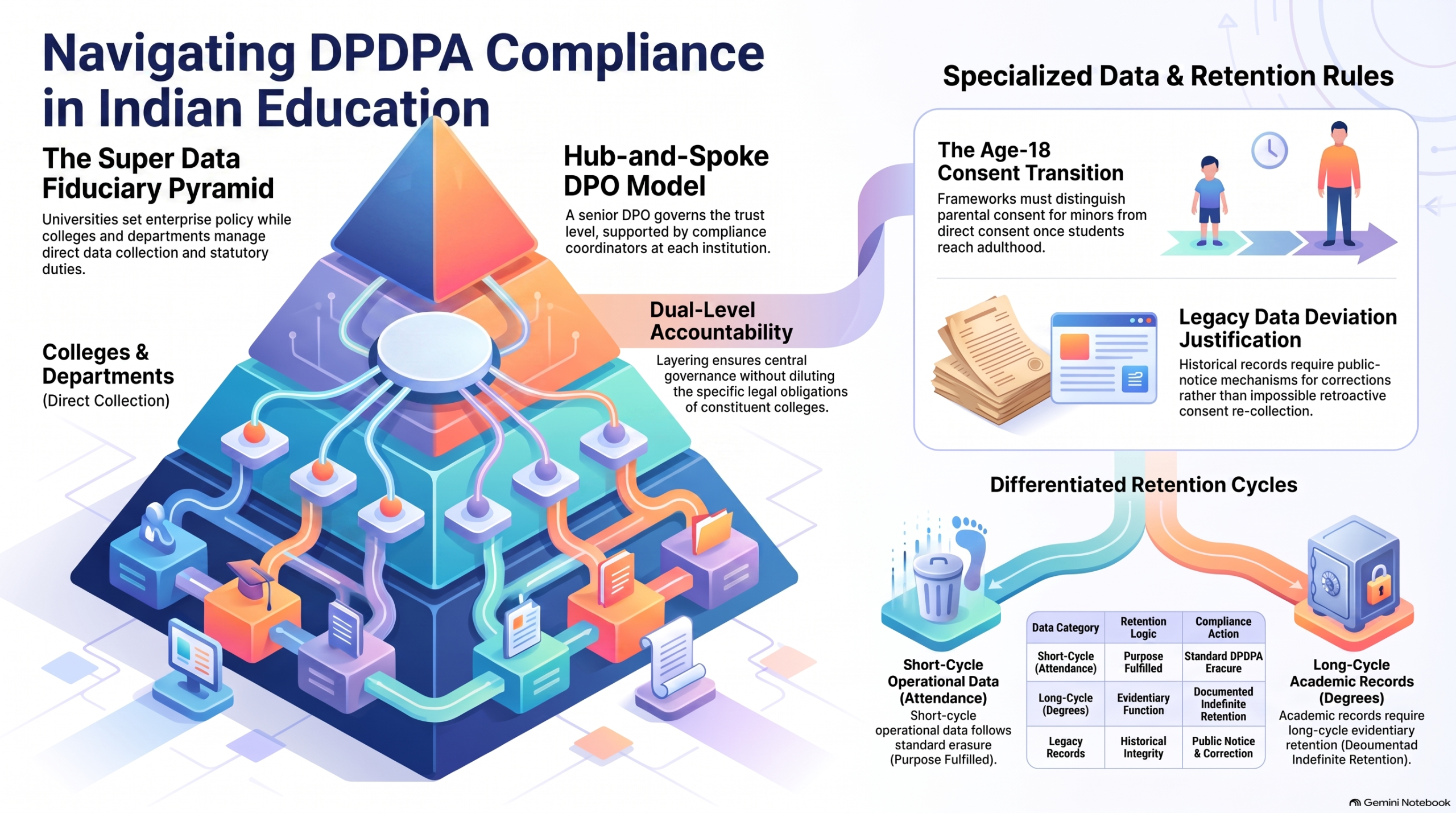
Education is one of the clearest use cases for the Super Data Fiduciary concept — a university sits at the top of the fiduciary pyramid on brand and governance grounds even though it rarely collects data directly, while autonomous colleges underneath it run admissions, examinations, and records (the real Data Fiduciary layer), and departments — teaching, research, library, sports, hostels — generate data as joint fiduciaries or processors within their own domains.
The framework needs to make explicit that this layering creates dual-level accountability, not diluted accountability.
the Super Data Fiduciary owns enterprise policy, consent standardization, cybersecurity architecture, and audit programs, while each constituent college or department keeps its own statutory obligations for consent, breach reporting, and Data Principal requests.
This matters most for university systems with autonomous colleges, online learning arms, research centres, examination boards, alumni bodies, and international campuses all trading on one institutional identity.
Many Universitites may also fall under the category of an “Instrumentality of State” and the available exemptions can be taken note of.
A legacy-data and consent regime built for decades-old records.
This is probably the single most distinctive problem education poses that generic DGPSI specifications find it difficult to address.
Institutions hold data going back decades with no realistic way to obtain verifiable consent retroactively, records where names exist only as initials and dates of birth are parental estimates rather than verified facts, and a genuine tension between correcting inaccurate historical data and preserving the integrity of academic records (degrees, transcripts) that third parties already rely on.
A workable framework needs its own addressable specification here: a public-notice mechanism inviting alumni/former students to flag corrections, retention of both original and corrected versions rather than overwriting, and a documented rationale (a Deviation Justification, in DGPSi’s own terms) for why full consent re-collection isn’t being pursued for legacy records.
Children’s data and the Schedule IV gap.
Most K-12 and much of higher-ed data involves minors, but DPDPA Rule 12-Schedule IV’s carve-out is narrow — it covers tracking children for health and safety purposes, not the broader sweep of admissions, academic, and behavioral data schools routinely process.
The framework needs its own consent architecture distinguishing verifiable parental consent for minors from direct consent once a student turns 18, a defined transition point for when consent obligations shift from parent to student, and explicit treatment of the categories Schedule IV doesn’t reach (academic performance data, disciplinary records, extracurricular tracking, biometric attendance systems).
For mentally disabled/challenged students, the roles of recognized intermediary institutions providing service to such students need to be harnessed.
DPO structure for multi-institution trusts.
Where a single trust or society runs multiple schools or colleges, the framework needs to settle whether one DPO covers the whole trust or each institution needs its own — currently an open question even in the base framework’s education discussion — and should probably default to a hub-and-spoke model: one senior DPO at the trust/Super Data Fiduciary level with designated compliance coordinators at each institution, mirroring how DGPSI’s five responsibility centers (managerial, DPO, HR, legal, technology) would need to be replicated per constituent college rather than assumed centralized.
Process-level classification true to DGPSI’s method.
Consistent with DGPSI treating an organization as an aggregation of processes rather than a monolith, an education variant should classify each functional stream separately: admissions and fee collection (fiduciary, high consent sensitivity), examinations and results (fiduciary, high accuracy/correction stakes), library and campus access systems (often processor relationships with vendors), placement and alumni relations (a distinct purpose limitation problem since data collected for education gets reused for career services), research data involving human subjects (its own consent and ethics-board overlap), and any proctoring, attendance, or campus surveillance technology (a likely candidate for Significant Data Fiduciary-level scrutiny given the scale and sensitivity of biometric and behavioral data).
The framework itself flags that education has been argued to qualify for Significant Data Fiduciary status yet gets no sectoral concessions in the Act — that gap is exactly where an education-specific standard needs to do the work the statute doesn’t.
Retention rules that match how long an institution’s records actually matter.
Educational records need to survive far longer than the “purpose fulfilled” test that governs commercial data — a degree or transcript may need verification thirty years later — so the framework needs a differentiated retention schedule: short-cycle data (attendance, day-to-day operational data) governed by ordinary DPDPA erasure timelines, and long-cycle data (degrees, transcripts, examination records) governed by a documented indefinite-retention justification tied to the record’s evidentiary function, not treated as a compliance failure by default.
Need for Government repository of data could be a solution to relieve the individual units of the burden of retention.
Cross-framework and cross-border mapping.
International campuses, foreign collaboration programs, and study-abroad data sharing put education institutions in the same GDPR/DPDPA dual-exposure position DGPSI already handles for commercial entities through data classification and silo segregation — an education variant should specify which student data streams sit under which regime rather than applying DPDPA controls uniformly.
It should also inherit DGPSI’s ITA 2000 breach cross-mapping given how often campus data breaches (exam leaks, admission portal compromises) trigger both statutes simultaneously.
A maturity and audit layer calibrated to the sector.
The Data Trust Score and three-tier readiness assessment (Excellent / Good / Requires Additional Measures) that DGPSI already uses for gap assessment would need education-specific weighting — legacy data handling, minor-consent architecture, and DPO structure across a multi-institution trust would logically carry more weight in an education Data Trust Score than they would in a typical commercial DGPSi-Lite assessment.
Use of APAAR ID
Use of APAAR ID as an instrument of identity management for the entire student life cycle and it’s transition to the Aadhaar ID should be engineered.
…More discussions to follow..
Naavi