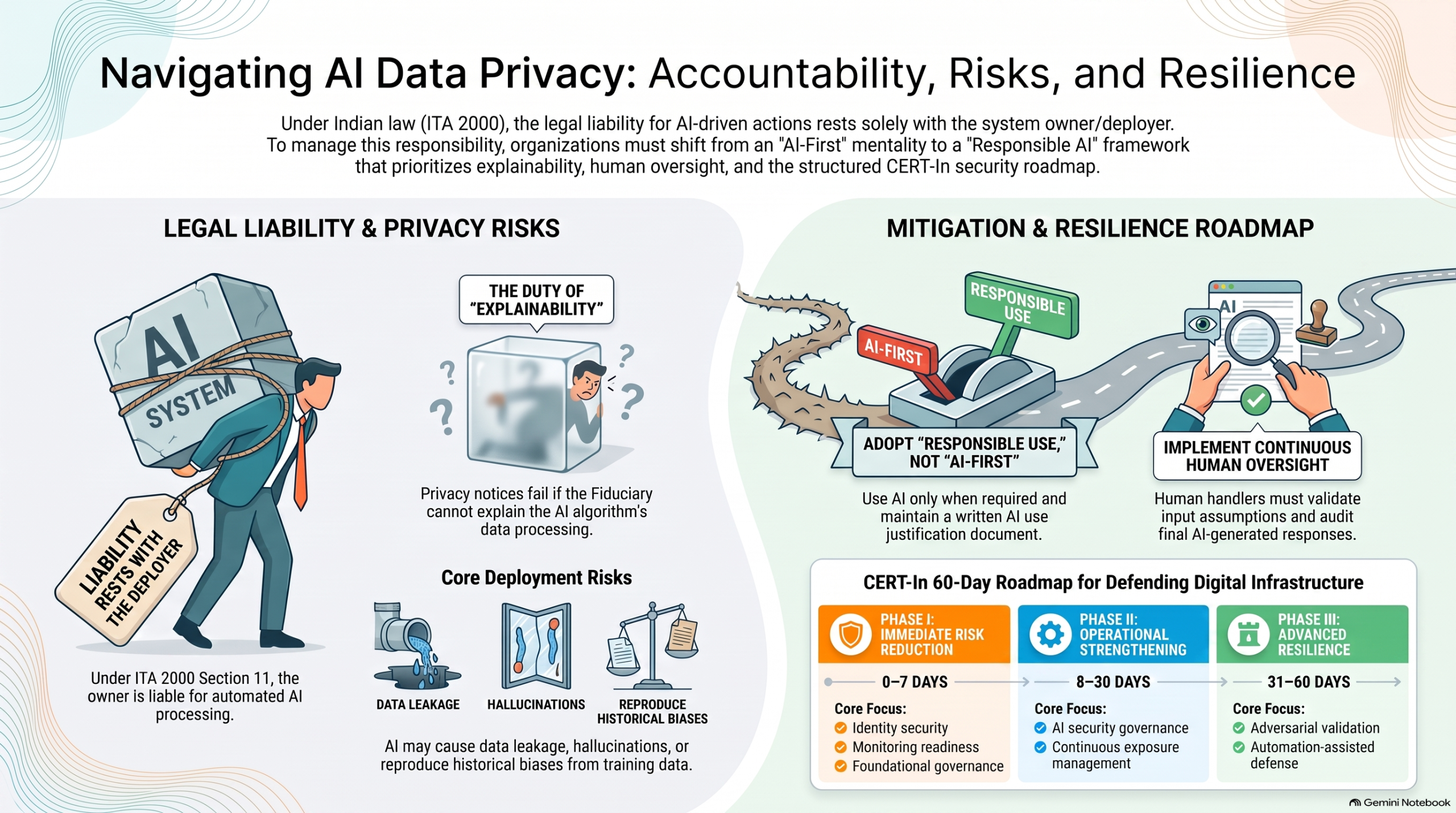
The siren song of “AI-First” is intoxicating. Corporate boardrooms across India are demanding rapid integration of Generative AI (GenAI) and automated systems to enhance efficiency and competitive edge. However, a stark visual reality check is required for every Indian CEO, CIO, and Legal Counsel. As the infographic accompanying this post illustrates so powerfully, the push for AI integration must be balanced against an equally powerful gravity: Total Legal Liability and Existential Privacy Risks.
At Naavi.org, we have long advocated that technology is a magnificent servant but a dangerous master. This has never been truer than with Artificial Intelligence.
The Chained Giant: The Myth of “AI Liability Immunity”
Let us be absolutely clear, as visualised on the left side of our guide:
“Under Indian law (ITA 2000), the legal liability for AI-driven actions rests solely with the system owner/deployer.”
There is a pervasive myth among less tech-legal-savvy organizations that if an “AI made a mistake,” it’s an unforeseeable event beyond human control. This is false.
We draw your direct attention to ITA 2000, Section 11. The statute does not recognize algorithms as sentient legal persons. When an AI processes data, generates a decision, or takes action on behalf of an organization, it is considered, for legal purposes, an extension of the data fiduciary or the system owner.
If your AI leaks personal data, hallucinating nonsensical answers that defame a client, or—just as dangerously—reproduces historical biases that lead to discriminatory hiring or lending, the law does not sanction the algorithm. It sanctions the Board of Directors.
The Fundamental Failure: Breach of the “Duty of Explainability”
Your privacy notices are only as good as your ability to justify them. We see another critical visual here: Privacy notices fail if the Fiduciary cannot explain the AI algorithm’s data processing.
The “Duty of Explainability” is a core principle. If you cannot explain to a data principal (the individual whose data is processed) how the AI reached its conclusion—meaning you treat it as a “black box”—you have effectively failed to provide valid notice and have breached your transparency obligations. This is an immediate red flag for enforcement bodies.
The Strategic Shift: From “AI-First” to “Responsible AI”
How do organizations avoid being crushed by this liability anchor? You must enact a fundamental cultural and technological shift.
We endorse the framework presented on the right side of the visual: We must transition from an “AI-First” mentality to a “Responsible AI” framework.
A Roadmap to Resilience and Mitigation
Your organization’s survival in the AI age requires moving through a structured roadmap that prioritizes safety over speed.
1. The “Responsible Use” Lever: Halt the AI Rush Visualize this shift: You must firmly pull the lever from the impulsive “AI-FIRST” position down to the deliberate “RESPONSIBLE USE” position.
Core Instruction: Use AI only when required and maintain a written AI use justification document. Just as with data minimization principles, “AI use minimization” should become a strategic pillar. Don’t use AI just because you can. Only use it when the business justification outweighs the significant liability and privacy risks.
2. Implement Continuous Human Oversight (The “Hand-on-the-Lever” Principle) We must resist the urge to believe the AI is autonomous. Human oversight is not a single point in time; it is continuous.
Core Instruction: Human handlers must validate input assumptions and audit final AI-generated responses. This “human-in-the-loop” approach is non-negotiable. Humans must remain the masters, auditing inputs and verifying outputs.
The Practical Defense: A Structured Security Roadmap via CERT-In
A “Responsible AI” framework must be underpinned by a mature cyber security posture. Organizations cannot secure AI without securing the infrastructure it sits on.
To give organizations a clear, actionable path, the infographic integrates a vital framework: The CERT-In 60-Day Roadmap for Defending Digital Infrastructure. This roadmap should be adopted immediately as your baseline security validation for any AI system deployment.
Phase I: Immediate Risk Reduction (0-7 Days)
The focus must be on foundational control:
-
Identity Security: Secure the credentials of users accessing and managing the AI.
-
Monitoring Readiness: Ensure logging is enabled so you can audit how the AI is being used.
-
Foundational Governance: Define who owns the liability of the system within the organization.
Phase II: Operational Strengthening (8-30 Days)
This moves into governance and risk visibility:
-
AI Security Governance: Establish explicit policies for AI use and risk tolerance.
-
Continuous Exposure Management: Regularly test the AI for vulnerabilities (like prompt injection attacks).
Phase III: Advanced Resilience (31-60 Days)
This is about continuous validation:
-
Adversarial Validation: ACTUALLY attack your AI to find how it breaks (e.g., trying to force it to leak data or hallucinate harmful content).
-
Automation-assisted Defense: Deploy advanced tools to help monitor the AI’s behavior in real-time.
In conclusion we can say that the weight of AI liability under Indian law is absolute. If you deploy AI, you cannot avoid the chains of accountability shown in our infographic. The only question is whether you let that weight crush you or build the resilient framework—prioritizing explainability, human oversight, and the structured CERT-In roadmap—that can turn AI into a manageable, albeit weighty, competitive advantage.
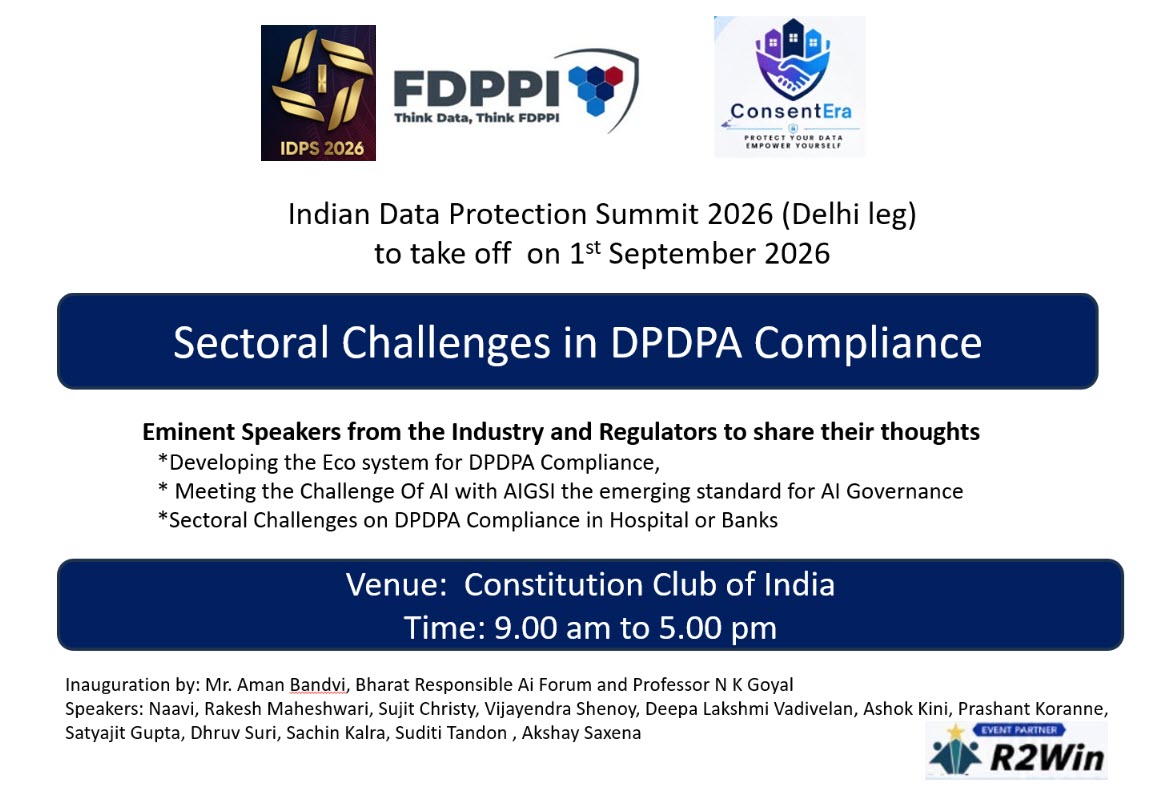
Listen more to this at the Delhi IDPS event on 1st September 2026 . Venue Constitutional Club of India.
 enquiry@consentera.com
Naavi