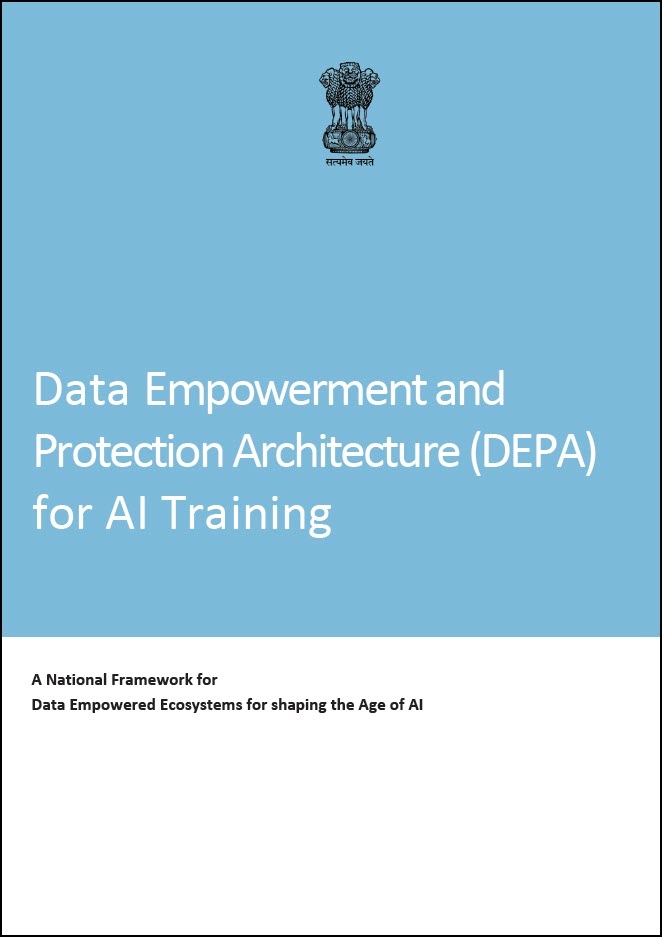
 DEPA for AI training, a document released for discussion by MeitY has been developed with the assistance of iSPIRT.
A detailed discussion on the document will be held at IDPS 2026 both at Bangalore on November 21, 2026 and at Hyderabad on November 28 2026.
Further the delegates can particiapte in a survey and express their views on different aspects of the framework.
The detailed online questionnaire will be made available after the event.
One of the key questions on which the survey is being conducted include
“Should access to DEPA-AIT be limited to Indian-owned and Indian-controlled entities? “
It is well known that India by virtue of its population and its high level of digital activity is a gold mine of information for the AI Model training activity. As a result all the global AI players eye on the Indian data and monetizing it through various means.
The DPDPA which is becoming effective from 13th May 2027 has been putting a hurdle on the “Personal Data Collection” exercise of the AI model trainers since questions are being asked about whether the “Permission to use personal data for a service” can automatically be considered as a permission with which a data fiduciary may share the data with a AI model trainer. Pareticularly when some of the data fiduciaries are Banks and Hospitals, they are “Signfiicant Data Fiduciaries” and are subject to DPIA and annudal data audit.
The DEPA-AIT cleverly builds an argument to legally by-pass DPDPA restrictions.
The document makes a reference to DEPA current architecture where a Consent manager in the mould of an account aggregator can obtain consent of the data principal, (which is called “DEPA Inference”, and states,
“While DEPA Inference manages the consented flow of individual data for inferencing (using an existing model), it isn’t designed to handle the privacy-preserving aggregation of bulk, de-identified data needed to build the AI models in the first place. The core issues are different.”
The discussion is then diverted to the security and “Anonymization” of data and concludes “individual consent via DEPA Inference is impractical at this scale and doesn’t solve the institutional risk problem.”
Further it states:
” DEPA Inference addresses consented sharing for individual benefit in specific transactions; it doesn’t provide the framework for secure, privacy-preserving pooling of aggregate data required for building powerful AI models. This necessitates DEPA for AI Training (and Data Sharing for AI Training Framework), a new layer designed specifically to unlock the value of aggregate data for AI training while upholding privacy and security through advanced technologies and governance mechanisms.”
“Without access to diverse, large-scale datasets, Indian startups, researchers, and even established companies outside the dominant tech giants would struggle to develop cutting-edge AI solutions tailored to local needs.”
The Training Data Providers under the scheme are the Data Fiduciaries who hold the Rs 850 crore liability hanging on their head and a new intermediary called “Data Collabs” is suggested as a vehicle to transport the data to the Model owners who are called the Training Data Consumers. Data Collabs are business centric, sector specific and conceptualized to be commercial players. The framework however does not call them “Data Brokers”.
The document also makes a comment
“AI is a complex, and rapidly evolving technology. Static, top-down regulations, enforced through manual screening or audits are ill-suited to the pace of this digital technology. “
In our considered view, the scheme DEPA for AI Training is designed to bypass DPDPA as a law diluting the permission control of the data principals to be informed and to be able to control the secondary processing of personal Data.
This will expose the data fiduciaries inclduing hospitals, Banks and the Government departments to the risk of penalties under DPDPA. The benefit on the other hand flows to the AI model developers who hold no DPDPA risks.
Since the use of the platrorm is not restricted to Indigenous model developers, the sovereign data is being handed over on a platter to the foreign AI players and this indicates a serious flaw in the logic whether it was intended or not.
If a tweaking of the law is required, it should be only to benefit the Indian start ups and Indian model developers and hence the access to the platform should have been strictly restricted to local companies with a fit and proper criteria. The Data Collabs should be considered as Data Fiduciaries themselves, completly insulating the Data Fiduciaries like hospitals and banks from the liabilities arising out of unauthorized use of personal data for AI model training.
I wish an appropriate Court takes a look at the model suo moto and give its views. Alternatively it should be taken to the Courts for opinion as a PIL case.
This is my personal view and others are free to differ.
iSPIRT which is the brain behind this scheme has been invited to the IDPS 2026 and we hope they attend and defend the framework against the above views.
Naavi